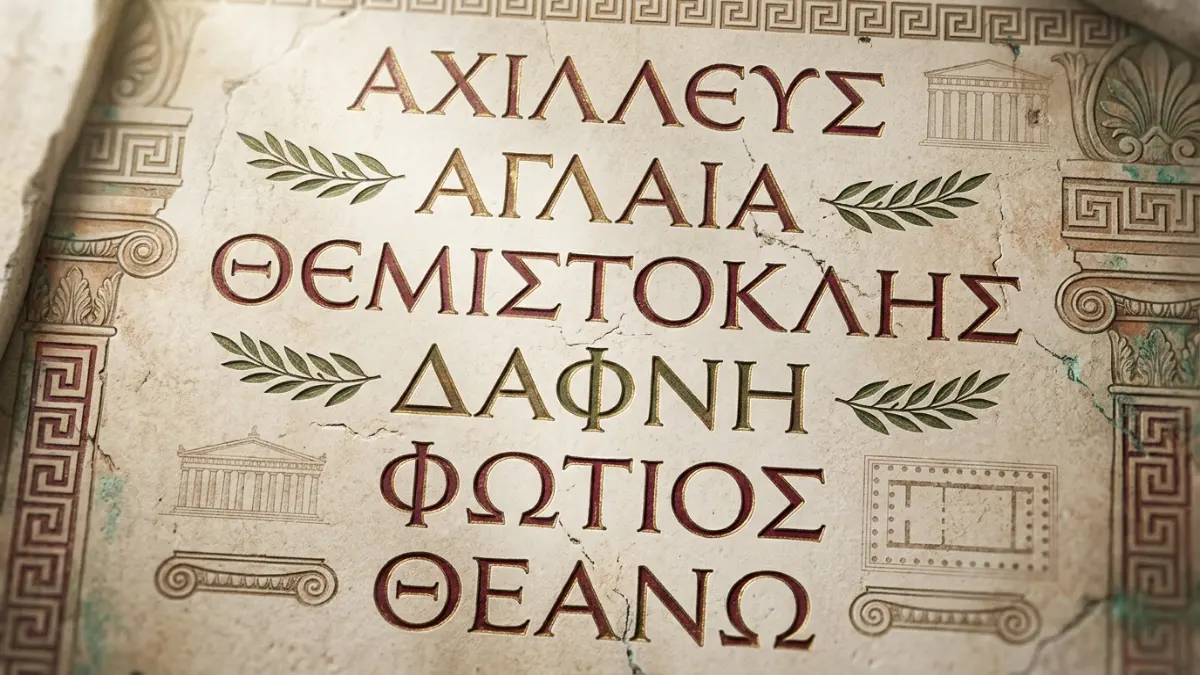
Feature Snippet:
Ancient Greek names carry a distinctive combination of history, mythology, philosophy, nature, strength, beauty, and virtue. Names such as Achilles, Leonidas, Penelope, Daphne, Helena, Theano, Socrates, and Pythagoras connect modern naming choices with people, stories, and ideas from the ancient Greek world. However, “ancient Greek” does not mean exactly the same thing as “Greek mythology.” Some names belonged to historical people, while others appear primarily in epic poetry or mythology. In addition, many ancient Greek names later developed modern Greek or Latinized forms.
Ancient Greek personal names often used Greek vocabulary elements to express qualities, relationships, religion, or aspirations. Many names contained two meaningful elements, while complete ancient names could also include a patronymic and, in some contexts, an indication of ethnicity or place.
This guide brings together Ancient Greek names for kids, distinctive mythological choices, historically documented names, meaningful options, and practical tips for choosing a name that fits your style.
Table of Contents
| Section | What You’ll Learn |
| What Counts as an Ancient Greek Name? | How ancient Greek names differ from modern Greek and mythological names |
| Ancient Greek Boy Names | Masculine names connected with history, philosophy, mythology, and Greek vocabulary |
| Ancient Greek Girl Names | Feminine names with historical, literary, mythological, and linguistic connections |
| Ancient Greek Names From Mythology | Names associated with gods, heroes, heroines, and legendary figures |
| Ancient Greek Names With Strong Meanings | Names connected with strength, victory, glory, beauty, and power |
| Ancient Greek Names Connected With Nature | Names associated with flowers, light, seas, landscapes, and the natural world |
| Rare and Distinctive Ancient Greek Names | Less familiar choices for readers seeking unusual names |
| Ancient Greek Naming Traditions | How naming worked in the ancient Greek world |
| How to Choose an Ancient Greek Name | Practical advice about spelling, pronunciation, meaning, and cultural context |
| Ancient Greek Names FAQs | Answers to common questions about origins and meanings |
What Counts as an Ancient Greek Name?
Ancient Greek names developed in the Greek speaking world during antiquity. They appeared across different periods and regions, so there was never one completely uniform naming system.
Moreover, an ancient Greek name may appear in several forms today. For example, Herodotos represents the Greek form of the name commonly rendered in English as Herodotus, while Themistokles corresponds to the Latinized Themistocles.
Ancient Greek names also came from several sources:
- Everyday Greek vocabulary
- Personal qualities and virtues
- Religious devotion
- Names of gods and goddesses
- Family relationships
- Places and ethnic identities
- Mythology and epic literature
- Historical and philosophical traditions
Ancient Greek vs. Greek Mythology Names

These categories overlap, but they are not identical.
Ancient Greek name describes a name used in the historical Greek speaking world of antiquity.
Greek mythology name refers to a name associated with a mythological character, deity, hero, or legendary figure.
For example, Themistokles belonged to a documented Athenian statesman and general, whereas Achilles appears primarily as the legendary hero of Homer’s Iliad. Both have ancient Greek associations, but their historical contexts differ.
| Category | Examples | Main Association |
| Historical | Themistokles, Perikles, Sappho | Documented ancient people |
| Philosophical | Socrates, Pythagoras, Herakleitos | Philosophy and scholarship |
| Mythological | Achilles, Antigone, Penelope | Greek legends and literature |
| Theophoric | Apollodoros, Diodoros, Athenodoros | Names connected with deities |
| Nature based | Daphne, Galene, Selene | Nature or celestial imagery |
Ancient Greek Boy Names
Ancient Greek masculine names often combine ideas such as strength, glory, victory, divine favor, wisdom, and beauty. Many also belonged to famous philosophers, historians, generals, mathematicians, and literary figures.
Classic Ancient Greek Boy Names
| Name | Meaning | Historical or Cultural Connection |
| Achilles | Uncertain | Hero of the Iliad |
| Alexandros | Defender of men | Ancient Greek form behind Alexander |
| Alcaeus | Strength, prowess | 7th century BC lyric poet |
| Diogenes | Born of Zeus | Greek philosopher |
| Diodoros | Gift of Zeus | Ancient Greek historian |
| Euclid | Good glory | Mathematician |
| Herakleitos | Glory of Hera | 6th century BC philosopher |
| Herodotos | Given by Hera | 5th century BC historian |
| Pythagoras | Traditionally linked with Apollo and an assembly/market | Philosopher and mathematician |
Several of these names have especially clear linguistic structures. For example, Diodoros combines Dios, “of Zeus,” with doron, “gift,” while Diogenes combines Dios with an element meaning “born.”
Ancient Greek Boy Names With Strength and Power
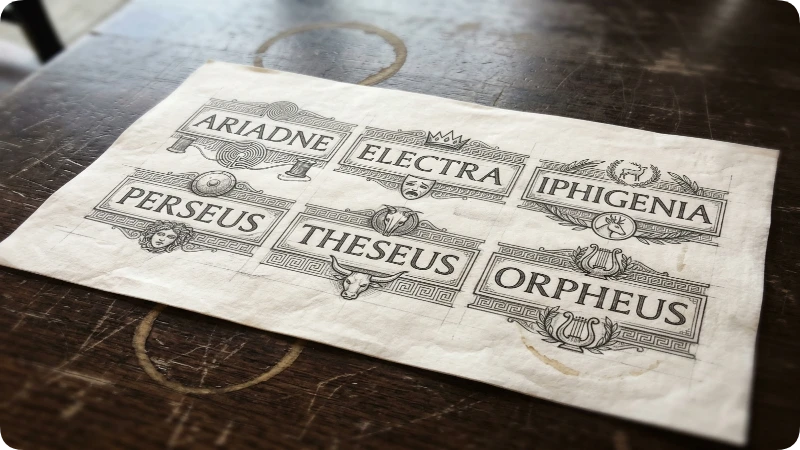
If you want a name with a strong meaning, Ancient Greek provides several choices.
Alcaeus comes from Greek alkē, meaning “strength” or “prowess.” The name belonged to the 7th century BC poet Alcaeus of Mytilene.
Alcibiades combines elements associated with strength and force. It belonged to the famous Athenian statesman and general of the Peloponnesian War.
Themistokles means “glory of the law,” combining themis, associated with divine law, custom, or natural order, with kleos, “glory.” The name belonged to an Athenian statesman and military leader associated with the Battle of Salamis.
| Name | Meaning or Element | Style |
| Alcaeus | Strength, prowess | Strong and literary |
| Alcibiades | Strength and force | Grand and historical |
| Kallikrates | Beautiful power | Formal and distinctive |
| Themistokles | Glory of the law | Historical and intellectual |
| Eratosthenes | Lovely + vigor/strength | Scholarly and unusual |
| Pancratius | All powerful | Rare and forceful |
Kallikrates has a particularly striking construction: kallos means “beauty,” while kratos means “power,” producing the meaning “beautiful power.” Kallinikos, meanwhile, means “beautiful victory.”
Ancient Greek Girl Names
Ancient Greek feminine names range from familiar choices such as Helena and Penelope to less familiar names such as Theano, Timarete, Pherenike, and Glaphyra.
Classic and Elegant Ancient Greek Girl Names
| Name | Meaning or Association | Style |
| Agape | Love | Virtuous and meaningful |
| Agathe | Good | Simple and classic |
| Aglaia | Splendor, beauty | Elegant and luminous |
| Antigone | Connected with birth/offspring | Dramatic and literary |
| Daphne | Laurel | Nature inspired |
| Helena | Traditional ancient name; exact etymology debated | Classic |
| Penelope | Traditional ancient name; etymology uncertain | Literary |
| Theano | Goddess | Philosophical and ancient |
| Timarete | Honor + virtue/excellence | Intellectual and distinctive |
| Xanthe | Yellow, golden/blond | Bright and unusual |
Aglaia means “splendor” or “beauty” and belonged to one of the three Graces in Greek mythology.
Timarete combines Greek elements associated with “honor” and “virtue” or “excellence.” It was also the name of a 5th century BC Greek painter.
Ancient Greek Girl Names With Literary and Historical Associations

Sappho stands out because it connects directly with one of antiquity’s most famous lyric poets. Corinna, or Korinna, also has a literary history: the ancient Greek form derives from korē, meaning “maiden,” and the name belonged to a Greek lyric poet of the 5th century BC
Theano offers another historically interesting choice. The name belonged to a 6th century BC Greek philosopher associated with Pythagoras, although the name also appears in Greek mythology.
Ancient Greek Names From Mythology
Greek mythology supplies some of the most recognizable ancient Greek names. However, mythology based names should remain clearly identified as literary or mythological associations rather than treated as ordinary historical names.
Mythological Girl Names
| Name | Mythological Association | Naming Style |
| Antigone | Daughter of Oedipus in Greek legend | Tragic and literary |
| Ariadne | Figure in Greek mythology | Elegant and mythological |
| Daphne | Nymph associated with Apollo | Nature inspired |
| Electra | Figure in Greek mythology | Dramatic |
| Eurydice | Figure in the Orpheus myth | Romantic and literary |
| Iphigenia | Daughter of Agamemnon | Ancient and dramatic |
| Leto | Titan mother of Apollo and Artemis | Short and mythological |
| Persephone | Queen of the underworld in mythology | Regal and distinctive |
| Selene | Goddess/personification of the moon | Celestial |
| Thalia | Muse and mythological figure | Bright and artistic |
Mythological Boy Names
| Name | Mythological Association | Naming Style |
| Achilles | Hero of the Iliad | Heroic |
| Apollo | Greek god | Musical and celestial |
| Dionysos | Greek god associated with wine and festivity | Mythological |
| Herakles | Hero known for his labors | Powerful |
| Hermes | Messenger god | Lively and distinctive |
| Odysseus | Hero of the Odyssey | Literary |
| Orpheus | Legendary musician and poet | Artistic |
| Perseus | Greek hero | Heroic |
| Theseus | Legendary king and hero | Historical mythic |
| Zeus | Chief Olympian deity | Extremely recognizable |
Achilles deserves a special note because its etymology remains uncertain. Sources have proposed connections with Greek achos, “pain,” or with the name of the Achelous River, but neither explanation should be presented as certain.
Ancient Greek Names Connected With the Gods
Ancient Greek naming traditions also produced theophoric names, which incorporated the names or attributes of deities.
For example, Apollodoros means “gift of Apollo,” while Athenodoros means “gift of Athena.” Dionysodoros means “gift of Dionysos,” and Artemidoros means “gift of Artemis.”
| Name | Divine Connection | Meaning |
| Apollodoros | Apollo | Gift of Apollo |
| Athenodoros | Athena | Gift of Athena |
| Artemidoros | Artemis | Gift of Artemis |
| Dionysodoros | Dionysos | Gift of Dionysos |
| Apollonides | Apollo | Son/descendant of Apollo |
| Dionysios | Dionysos | Derived from Dionysos |
| Demetrios | Demeter | Derived from Demeter |
| Poseidonios | Poseidon | Derived from Poseidon |
This naming pattern demonstrates how religion and personal naming could intersect in ancient Greek culture.
Ancient Greek Names With Beautiful Meanings
If meaning matters more than mythology, several ancient Greek names offer attractive choices.
Aglaia connects with “splendor” and “beauty,” while Agathe derives from Greek agathos, meaning “good.” Chares relates to charis, meaning “grace” or “kindness.”
Kallikrates means “beautiful power,” and Kallippos means “beautiful horse,” combining kallos, “beauty,” with hippos, “horse.”
| Name | Meaning | Gender |
| Agape | Love | Feminine |
| Agathe | Good | Feminine |
| Aglaia | Splendor, beauty | Feminine |
| Chares | Grace, kindness | Masculine |
| Kallikrates | Beautiful power | Masculine |
| Kallinikos | Beautiful victory | Masculine |
| Kallippos | Beautiful horse | Masculine |
| Photios | Light | Masculine |
Photios derives from Greek phōs, meaning “light.” Therefore, it can appeal to readers looking for an ancient Greek name with a direct luminous association.
Ancient Greek Names Inspired by Nature
Ancient Greek naming traditions also contain names connected with natural imagery.
Daphne has a particularly recognizable nature association because the Greek word refers to the laurel. Galene means “calm” and also appears as the name of a minor Greek goddess associated with calm seas.
Glaukos, commonly Latinized as Glaucus, means “bluish gray.” The name also belonged to mythological figures, including a sea god.
| Name | Nature Connection | Style |
| Daphne | Laurel | Botanical |
| Galene | Calm seas | Ocean inspired |
| Glaukos | Bluish gray | Unusual |
| Selene | Moon | Celestial |
| Asterios | Star related | Celestial |
| Xanthe | Yellow or golden/blond | Color inspired |
| Melanthios | Dark/black + flower | Floral and dramatic |
| Actaea | Shore or headland | Coastal |
Melanthios combines Greek melas, “black” or “dark,” with anthos, “flower.” The name appears in Homer’s Odyssey as the name of a goatherd.
Rare and Distinctive Ancient Greek Names
If you want something less familiar, you can look beyond the most recognizable mythology names.
Names such as Pherenike, Timarete, Glaphyra, Themistokleia, Kallikrates, Eratosthenes, Asterios, and Theokritos offer a more unusual ancient character.
However, “rare” should remain contextual. A name can feel uncommon to modern English speakers without being historically rare within the ancient Greek world.
Less Familiar Ancient Greek Names
| Name | Meaning or Association | Why It Stands Out |
| Glaphyra | Polished, subtle | Uncommon sound |
| Pherenike | Bringing victory | Strong meaning |
| Timarete | Honor + virtue | Historical connection |
| Theano | Goddess | Philosophical history |
| Themistokleia | Feminine form of Themistokles | Strong historical feel |
| Kallikrates | Beautiful power | Distinctive compound |
| Eratosthenes | Lovely + vigor | Scholarly |
| Theokritos | Judge of god | Literary |
| Asterios | Star related | Celestial |
| Argyros | Silver | Metallic/nature imagery |
Argyros means “silver” in Greek, making it an appealing option for someone who wants a short ancient name with a direct word meaning. Bion, meanwhile, derives from Greek bios, meaning “life.”
Ancient Greek Names From History and Philosophy
Ancient Greece produced philosophers, mathematicians, historians, poets, playwrights, physicians, artists, and political leaders whose names remain recognizable.
Some historically associated names include:
- Aeschylus — Athenian playwright
- Alcaeus — lyric poet
- Alcibiades — statesman and general
- Diogenes — philosopher
- Euclid — mathematician
- Herakleitos — philosopher
- Herodotos — historian
- Perikles — Athenian statesman
- Pythagoras — philosopher and mathematician
- Sappho — lyric poet
- Socrates — philosopher
- Sophokles — playwright
- Themistokles — statesman and general
- Theano — philosopher associated with Pythagoras
For example, Euclid comes from Greek Eukleides, built from eu, “good,” and kleos, “glory,” together with a patronymic suffix.
Likewise, Herodotos has a theophoric construction involving Hera and an element meaning “given” or “granted.”
How Ancient Greek Names Were Formed
Ancient Greek names often followed recognizable linguistic patterns. Many personal names used two elements derived from ordinary Greek vocabulary.
For example:
- Diodoros = associated with Zeus + gift
- Apollodoros = Apollo + gift
- Kallikrates = beauty + power
- Kallinikos = beauty + victory
- Themistokles = divine law/custom + glory
- Eratosthenes = lovely + vigor/strength
This structure explains why so many ancient Greek names seem elaborate. Rather than being arbitrary combinations, many names incorporated meaningful Greek words.
Ancient Greek people could also use a patronymic and, in some contexts, an ethnic designation alongside a given name.
Ancient Greek Names vs. Modern Greek Forms
Some ancient names remain recognizable today, but their spelling or pronunciation may change in modern Greek.
For example, modern Greek has forms such as Afroditi for Aphrodite, Persefoni for Persephone, Pinelopi for Penelope, and Periklis for Pericles.
Therefore, decide whether you want:
- The original or reconstructed ancient form
- A Latinized English form
- A modern Greek form
- A historically inspired name that works naturally in English
These choices can produce very different results.
| Ancient Greek Form | Common English/Latinized Form | Modern Greek Example |
| Achilleus | Achilles | Achilleas |
| Alexandros | Alexander | Alexandros |
| Herodotos | Herodotus | Herodotos |
| Perikles | Pericles | Periklis |
| Persephone | Persephone | Persefoni |
| Penelope | Penelope | Pinelopi |
| Aphrodite | Aphrodite | Afroditi |
Not every modern form should be treated as identical to the ancient form. Historical development, transliteration, and pronunciation can change across periods.
How to Choose an Ancient Greek Name
An ancient Greek name can sound beautiful while still creating practical questions in everyday use. Before choosing one, consider the following.
Check the Meaning
First, determine whether you want a literal lexical meaning, a traditional interpretation, or a mythological association.
For example, Agape directly relates to “love,” while Daphne has a botanical connection. Meanwhile, Achilles has an uncertain etymology, so it would be misleading to assign it one definitive meaning.
Decide Between Historical and Mythological Names
If you want a historically documented feel, names connected with philosophers, poets, mathematicians, or statesmen may work better.
If you prefer dramatic storytelling, mythology offers choices such as Perseus, Ariadne, Electra, Odysseus, and Antigone.
Consider the Modern Spelling
A name can have several established forms. For an English speaking audience, a Latinized form may feel more familiar, while the Greek form can provide a stronger connection to the original language.
Think About Pronunciation
Names such as Themistokles, Pherenike, Eratosthenes, and Kallikrates may require explanation in English speaking settings.
If pronunciation matters to you, consider whether the original Greek form or a commonly established English form will work better.
Consider the Cultural Context
A name associated with a god, hero, philosopher, or literary character carries more than a dictionary meaning. Athena, for example, immediately evokes Greek mythology, while Socrates evokes classical philosophy.
For this reason, consider whether you want the historical or mythological association to remain obvious.
20 More Ancient Greek Names to Explore
If you want an even broader selection, these names provide additional possibilities:
Male and masculine names:
- Apollodoros
- Apollonios
- Asterios
- Diodotos
- Dion
- Dionysios
- Hermogenes
- Hermokrates
- Leonidas
- Nikias
Female and feminine names:
- Anthousa
- Demostrate
- Eirene
- Galene
- Olympias
- Parthena
- Phila
- Pherenike
- Theokleia
- Theophila
Several of these names have direct linguistic or historical documentation. For example, Diodotos means “given by Zeus,” Hermogenes means “born of Hermes,” and Hermokrates means “power of Hermes.”
10 Ancient Greek Names With Especially Clear Meanings
If your priority is meaning rather than mythology, start with names whose linguistic elements have relatively clear explanations.
| Name | Meaning | Gender |
| Agape | Love | Feminine |
| Agathe | Good | Feminine |
| Alcaeus | Strength, prowess | Masculine |
| Argyros | Silver | Masculine |
| Bion | Life | Masculine |
| Diodoros | Gift of Zeus | Masculine |
| Kallikrates | Beautiful power | Masculine |
| Kallinikos | Beautiful victory | Masculine |
| Photios | Light | Masculine |
| Timarete | Honor + virtue/excellence | Feminine |
These examples illustrate an important point: ancient Greek names can derive from ordinary vocabulary, personal qualities, religious concepts, and combinations of meaningful elements.
Frequently Asked Questions About Ancient Greek Names
What is a good ancient Greek name?
The right choice depends on the style and meaning you want. Daphne, Aglaia, Theano, Penelope, Achilles, Leonidas, Alcaeus, and Pythagoras offer very different ancient Greek associations, so consider whether you prefer mythology, history, nature, philosophy, or a particular meaning.
What is a rare ancient Greek name?
Names such as Pherenike, Timarete, Glaphyra, Kallikrates, Themistokleia, and Eratosthenes may feel less familiar to modern English speakers. However, “rare” should remain contextual because historical frequency varied across regions and periods.
What ancient Greek girl names are beautiful?
Names such as Aglaia, Daphne, Helena, Penelope, Theano, Selene, Ariadne, and Thalia offer different forms of beauty, from nature and mythology to literature and history.
What ancient Greek boy names mean strength?
Alcaeus directly connects with Greek alkē, meaning “strength” or “prowess.” Alcibiades also contains elements associated with strength and force.
What ancient Greek name means love?
Agape derives from Greek agapē, meaning “love.” The word also has an important history in Greek religious vocabulary, so its cultural associations extend beyond its use as a personal name.
Are Greek mythology names the same as ancient Greek names?
No. The categories overlap, but they are not identical. Some ancient Greek names belonged to historical people, while others appear mainly in mythology or epic literature. Themistokles, for example, was a historical Athenian statesman, while Achilles is primarily known as a legendary hero.
What ancient Greek names mean beauty?
Aglaia means “splendor, beauty,” while Kallikrates combines Greek elements meaning “beauty” and “power.” Kallippos similarly combines “beauty” with “horse.”
What ancient Greek names are connected with gods?
Names such as Apollodoros, Athenodoros, Artemidoros, Dionysodoros, and Apollonides have direct connections with Greek deities. Their constructions incorporate divine names or elements associated with those deities.
What ancient Greek name means light?
Photios derives from Greek phōs, meaning “light.” It provides a more direct connection to the concept than a name that merely has a symbolic association with brightness.
How should I choose an ancient Greek name?
Start with the quality you want the name to express, then verify its original meaning, historical usage, spelling, pronunciation, and cultural associations. Finally, say the name alongside the surname to see whether the complete combination feels natural.
Key Takeaways
- Ancient Greek names include historical, philosophical, literary, mythological, religious, and nature inspired choices.
- Ancient Greek names and Greek mythology names overlap, but they are not interchangeable categories.
- Many ancient Greek names combine two meaningful Greek elements, such as beauty + power or deity + gift.
- Agape means “love,” while Aglaia means “splendor, beauty.”
- Alcaeus connects with strength and prowess, while Photios derives from a Greek word meaning “light.”
- Theophoric names such as Apollodoros and Athenodoros connect personal names with Greek deities.
- Some famous ancient names have uncertain etymologies, so avoid assigning them unsupported meanings.
- Latinized, English, ancient Greek, and modern Greek forms can differ.
- The strongest name choice depends on your preferred meaning, sound, historical association, cultural context, and spelling.
Conclusion
Ancient Greek names offer far more than familiar mythological choices. They connect naming with philosophy, poetry, history, nature, religion, virtue, beauty, strength, and Greek vocabulary. If you prefer meaningful names, Agape, Aglaia, Alcaeus, Photios, and Kallikrates provide clear linguistic associations. If mythology appeals to you, Daphne, Persephone, Selene, Achilles, Perseus, and Odysseus offer powerful literary connections. Meanwhile, names such as Theano, Sappho, Euclid, Herodotos, and Themistokles connect directly with important figures from ancient Greek intellectual and cultural history. Most importantly, check whether a name’s meaning is etymological, literary, mythological, or modern before treating it as a definitive definition. That distinction makes an ancient Greek naming guide more accurate and helps you choose a name with a connection you genuinely value.

Leave a Reply