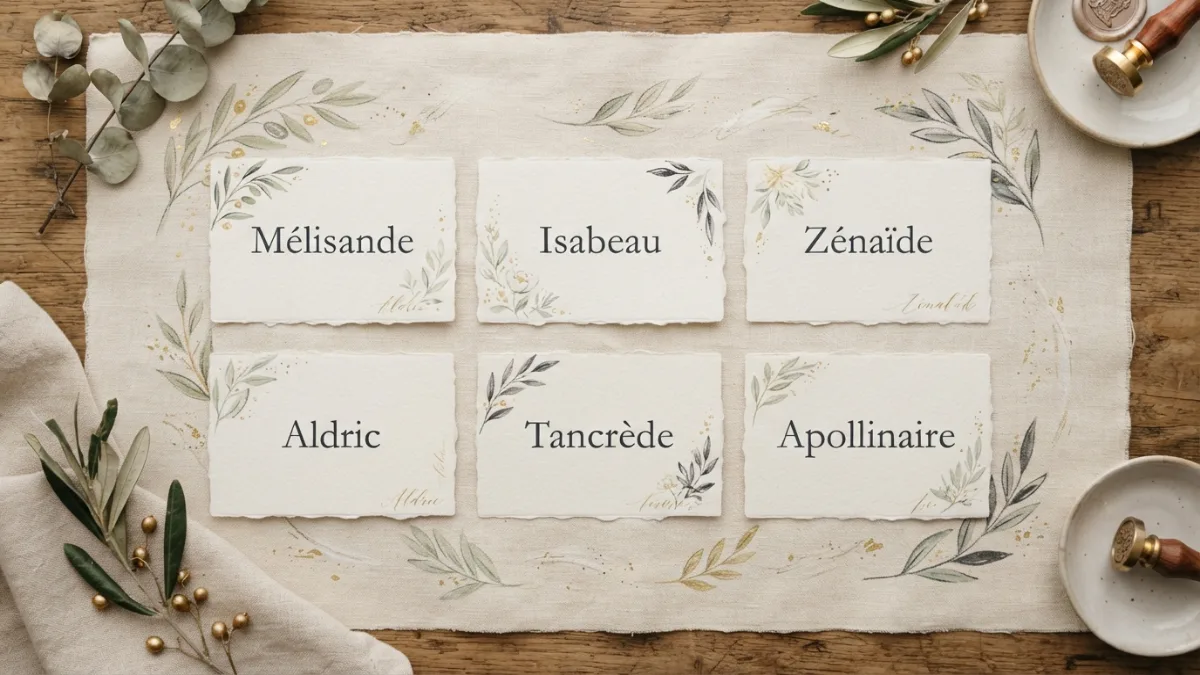
Feature Snippet:
French names often combine elegant sounds, rich history, and distinctive spellings. If you want a name that feels refined without choosing an overly familiar option, rare French names offer plenty of inspiration. From vintage names that deserve another look to traditional French forms and distinctive names rooted in French vocabulary, there are many possibilities to explore.
Some names on this list have a long history in France, while others come from regional traditions, older French usage, or words shared with other languages. Importantly, a name that feels rare in the United States may be more familiar in France or another French speaking community.
This guide explores rare French girl names, boy names, unisex possibilities, historical choices, and names with beautiful meanings. It also explains pronunciation and cultural background so you can choose a name that suits your preferences.
Table of Contents
| Section | What You’ll Learn |
| What Makes a French Name Rare? | How rarity depends on country, era, and usage |
| Rare French Girl Names | Distinctive feminine names and their backgrounds |
| Rare French Boy Names | Traditional and less familiar masculine names |
| French Names With Beautiful Meanings | Names connected with nature, virtues, and symbolism |
| Vintage and Historical French Names | Older names with distinctive character |
| French Unisex and Word Names | Names and words with broader or modern usage |
| How to Choose a Rare French Name | Practical tips for pronunciation, spelling, and cultural fit |
| FAQs | Answers to common questions about rare French names |
What Makes a French Name Rare?
A rare French name is not necessarily a name that nobody uses. Instead, it may be uncommon in a particular country, associated with an earlier generation, or less familiar outside French speaking communities.
For example, some traditional names have become less fashionable in certain generations, while others remain familiar in France but feel unusual to English speaking parents. Regional French names can also differ from names traditionally associated with Paris or metropolitan France.
Consider these factors when exploring rare French names:
- Historical usage: Some names appeared more frequently in earlier generations.
- Regional heritage: Names from Brittany, Occitania, and other regions may have distinct linguistic roots.
- Spelling: French accents and letter combinations can make a familiar name look distinctive.
- International familiarity: A name that is common in France may feel unusual elsewhere.
- Meaning and sound: Some people prefer names with nature associations, while others favor short, elegant, or traditional forms.
For a genuinely rare choice, check official French birth name statistics or another relevant national dataset. The selections below emphasize distinctive or less familiar options rather than claiming that every name has a verified low ranking.
Rare French Girl Names With Elegant Sounds
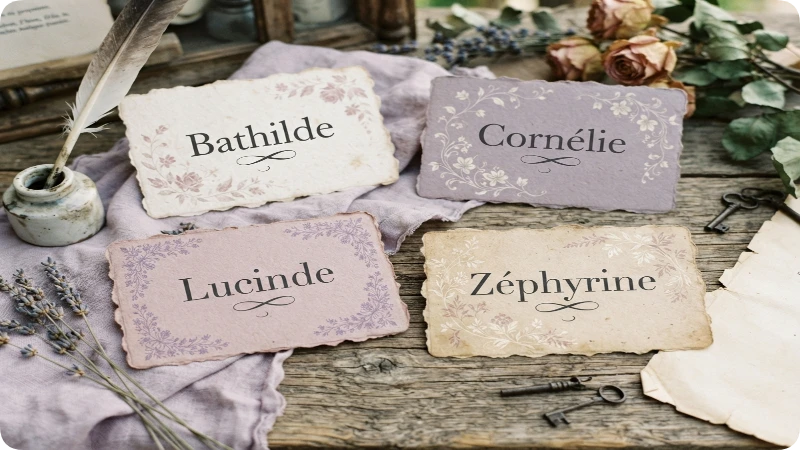
French feminine names range from delicate and lyrical to medieval and dramatic. The following options include names that reference French language sources as rare, along with historical forms that offer a distinctive alternative to more familiar choices.
Vintage and Distinctive French Girl Names
| Name | Meaning or Background | Origin and Style |
| Azélie | Possibly related to Azalaïs; exact development is uncertain | French; vintage and delicate |
| Bathilde | Associated with Germanic elements meaning “battle” | French form with medieval history |
| Isabeau | Medieval French variant of Isabel | Historical and regal |
| Mélisande | French form of Millicent | Literary and romantic |
| Zéphyrine | Feminine form of Zephyrinus | French; airy and distinctive |
| Yseult | French form of Iseult | Medieval literary heritage |
| Cornélie | French form of Cornelia | Classical and refined |
| Lucinde | French form of Lucinda | Literary and elegant |
These names appeal to different tastes. For example, Isabeau suits someone who loves medieval French history, while Mélisande has a literary association through Maurice Maeterlinck’s play Pelléas et Mélisande. Meanwhile, Azélie offers a softer sound and a connection to Saint Marie Azélie Guérin.
Uncommon French Girl Names Inspired by Flowers and Nature
| Name | Meaning or Connection | Style |
| Amarante | French form of Amarantha; connected with the amaranth name family | Botanical and unusual |
| Fleurette | French diminutive of Fleur | Delicate and floral |
| Florette | French diminutive of Flora | Vintage and gentle |
| Jacinthe | French cognate of Hyacinth | Botanical and traditional |
| Avril | French form of April | Fresh and concise |
| Mirabelle | From Old French mirable, “wonderful” | Sweet and vintage |
| Amour | French form of Amor; the French word means “love” | Romantic and word inspired |
| Zénaïde | French form of Zenaida | Classical and distinctive |
The connection matters when selecting a name for its meaning. Amarante belongs to a botanical name family, while Amour directly matches a French word. Mirabelle, despite its association with the French plum, has a name history connected with the Old French word for “wonderful.”
Rare French Boy Names With Historical Character
French masculine names can draw on medieval history, Latin forms, Germanic roots, and literary traditions. Some sound familiar to French speakers but remain less recognizable internationally.
Traditional and Uncommon French Boy Names
| Name | Meaning or Background | Style |
| Aldric | Germanic elements meaning “old” and “ruler” | Strong and historical |
| Anthelme | French form of Anthelm | Medieval and distinctive |
| Apollinaire | French form of Apollinaris | Literary and artistic |
| Césaire | French form of Caesarius | Classical and scholarly |
| Déodat | French form of Deodatus | Historical and uncommon |
| Diodore | French form of Diodorus | Classical and formal |
| Fiacre | French form of Fiachra | Traditional and distinctive |
| Tancrède | French form of Tancred | Medieval and dramatic |
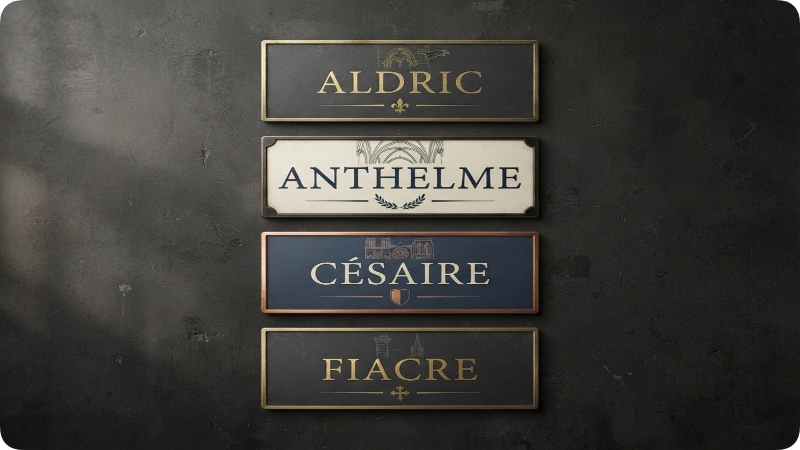
These names offer several different styles. Aldric has a Germanic meaning associated with an old ruler, whereas Apollinaire evokes French literary history through the poet Guillaume Apollinaire. Tancrède, meanwhile, has a connection to French opera and literature.
More Rare French Masculine Names to Consider
| Name | Background | Why It Stands Out |
| Arsène | French form of Arsenios | Literary associations through Arsène Lupin |
| Corin | French form of Quirinus | Short and understated |
| Donat | French form of Donatus; also used in Polish | Brief and traditional |
| Josse | French form of Iudocus | Medieval French heritage |
| Mardochée | French form of Mordecai | Biblical and distinctive |
| Sixte | French form of Sixtus | Concise and historical |
| Venceslas | French form of Václav through Latin Venceslaus | Formal and old world |
| Babylas | Ancient name associated with Saint Babylas | Historical and unusual |
These options are documented in French name references, although their familiarity varies by country and period.
If you want a name that feels uncommon without sounding excessively elaborate, consider Corin, Arsène, or Aldric. For a more historical style, Josse and Sixte offer shorter alternatives.
Rare French Names With Beautiful Meanings
A name’s origin and meaning can matter as much as its sound. However, French usage does not always mean that a name originated in French. Some French forms descend from Greek, Latin, Hebrew, or Germanic names.
French Names Connected With Love, Desire, and Blessing
| Name | Meaning or Background | Usage |
| Amour | French word for “love”; French form of Amor | Rare feminine and masculine usage |
| Aimé | Related to Old French amé, “beloved” | Masculine |
| Aimée | Feminine form associated with “beloved” | Feminine |
| Désiré | French masculine form of Désirée; connected with being desired | Masculine |
| Désirée | Related to the French word for “desired” or “wished for” | Feminine |
| Dieudonné | “Given by God” | Masculine |
| Dieudonnée | Feminine form of Dieudonné | Feminine |
| Candide | French form of Candidus or Candida; French word meaning “naive” | Masculine and feminine |
These names communicate different ideas. Aimé and Aimée relate to being beloved, while Désiré and Désirée express being desired or wished for. Dieudonné carries an explicit religious meaning. By contrast, Candide has both a historical name background and a French vocabulary meaning.
French Names With Classical or Literary Associations
| Name | Association | Best Suited to |
| Guenièvre | French form of Guinevere | Arthurian and medieval themes |
| Cunégonde | French form of Kunigunde; used by Voltaire in Candide | Literary and historical tastes |
| Haydée | Appears in Lord Byron’s Don Juan and Alexandre Dumas’s The Count of Monte Cristo | Literary inspiration |
| Pétronille | French form of Petronilla | Vintage and historical style |
| Ursule | French form of Ursula | Traditional and understated style |
| Vérène | French form of Verena | Classic and uncommon |
| Laurentine | French feminine form of Laurentinus | Formal and vintage |
| Maximilienne | French feminine form of Maximilian | Grand and traditional |
Literary associations can make a name memorable, but they do not necessarily explain its original meaning. For example, Guenièvre has an Arthurian connection, while Haydée is linked to literary characters. Choose these names for their history and sound rather than assigning them an unsupported symbolic meaning.
Rare French Unisex Names and Distinctive Word Names
French naming traditions include a small number of names used for more than one gender. However, usage may differ by region and historical period, so a name’s classification deserves care.
French Names Used for More Than One Gender
| Name | Background | Naming Style |
| Alix | Medieval French variant of Alice, also sometimes masculine | Short and classic |
| Amour | French form of Amor | Romantic and word inspired |
| Arcade | French masculine and feminine form of Arcadius | Historical and literary |
| Cyrille | French form of Cyril; also used as feminine | Traditional and versatile |
| Léonce | French form of Leontios, also used as feminine | Vintage and refined |
| Ange | French masculine and feminine form of Angelus | Simple and symbolic |
These names have documented use across genders in French, although that does not mean they occur equally often for each gender. Alix is especially interesting because its medieval French history includes both feminine and masculine use.
French Word Names for a Distinctive Choice
French vocabulary also provides inspiration for modern word names. These options should be distinguished from inherited traditional names because a word’s meaning does not automatically establish its history as a given name.
| Word | French Meaning | Naming Consideration |
| Automne | Autumn | Seasonal and modern |
| Cerise | Cherry | Sweet and botanical |
| Bijou | Jewel | Decorative and distinctive |
| Alizée | Trade wind, from alizé | Airy and nature inspired |
| Fleur | Flower | Classic and floral |
| Ambre | Amber | Warm and nature inspired |
Automne is a modern French word name, while Alizée derives from the French word alizé, meaning “trade wind.” Bijou has documented use as a name, especially in French speaking Africa, so its cultural context is worth noting.
If you want a name that clearly feels French but remains accessible to English speakers, Fleur, Ambre, and Cerise may appeal to you. If you prefer something more unusual, Automne or Alizée offers a distinctive alternative.
Vintage French Names That Deserve a Second Look

Older names can feel fresh when they fall outside current naming habits. Nevertheless, vintage does not automatically mean rare, and rarity can change over time.
Consider these names if you enjoy historical French forms:
- Madelon: A French diminutive of Madeleine; it is now more common as a Dutch name than a French one.
- Baptistine: The feminine form of Baptiste.
- Flavienne: The French feminine form of Flavian.
- Léonne: A French feminine form of Léon.
- Laurentine: A feminine form of Laurentinus.
- Arnaude: The French feminine form of Arnold.
- Marcellette: A French feminine diminutive of Marcellus.
- Maximilienne: A feminine form of Maximilian.
These forms suit readers who appreciate historical naming traditions, although some may feel formal or unfamiliar in everyday English.
How to Choose the Right Rare French Name
A distinctive name should work beyond the page. Therefore, consider how it sounds, looks, and functions in the language and community where you plan to use it.
1. Decide Which French Naming Style You Prefer
First, narrow your choices by style.
- Elegant and feminine: Mélisande, Isabeau, Zénaïde
- Strong and historical: Aldric, Tancrède, Anthelme
- Soft and floral: Fleurette, Florette, Amarante
- Short and understated: Alix, Corin, Josse
- Romantic or symbolic: Aimée, Amour, Désirée
- Literary and medieval: Guenièvre, Yseult, Apollinaire
These are subjective style impressions, not claims about what every French speaker would associate with each name.
2. Check the Original Meaning and Language
Some names have French vocabulary meanings, while others are French forms of older names from different languages. For example, Amour means “love” in French, whereas Aldric has Germanic roots. Similarly, Isabeau belongs to the history of medieval French forms rather than originating as a modern French word.
For this reason, check whether you prefer a name that originated in French or one that has a long history of French use.
3. Practice the French Pronunciation
French pronunciation can differ substantially from English pronunciation. Before choosing a name, listen to a reliable French language pronunciation reference and practice saying it aloud.
Pay particular attention to:
- Accent marks, such as the é in Zénaïde
- Nasal vowel sounds
- Final consonants that may be silent
- French vowel combinations
- Differences between French and English pronunciation
You may also want to decide whether you will use the original French pronunciation or a locally adapted version.
4. Think About Spelling and Everyday Use
Names such as Mélisande, Zéphyrine, and Cunégonde may require spelling explanations in some English speaking settings. Meanwhile, shorter options such as Alix or Corin may be easier for some people to remember.
Neither approach is inherently better. Choose the spelling that respects the name’s heritage and suits your practical preferences.
5. Check Cultural and Regional Fit
French speaking communities include France, Belgium, Switzerland, Canada, and many countries in Africa, among others. Naming conventions can differ significantly across these communities.
If cultural heritage is important to you, investigate a name’s actual regional usage rather than assuming that every French language name belongs exclusively to France. Likewise, if you plan to use a Breton or other regional name, research that language’s distinct history.
6. Verify Rarity Before Making a Final Choice
If you want a name that is genuinely uncommon today, consult official birth name statistics for the relevant country. In France, the national statistics institute INSEE publishes first name data that can help you investigate usage over time.
A name can be historically rare but experience a revival. Conversely, a name that feels unusual internationally may have more established use in France.
Frequently Asked Questions About Rare French Names
1. What are some rare French girl names?
Some distinctive options include Azélie, Bathilde, Isabeau, Mélisande, Zéphyrine, Yseult, Cornélie, and Lucinde. These names have documented French usage or French historical forms, although their current popularity varies.
2. What are some rare French boy names?
Consider Aldric, Anthelme, Apollinaire, Césaire, Déodat, Diodore, Fiacre, and Tancrède. These names draw on French forms of older Germanic, Greek, and Latin names and have different historical associations.
3. What French name means love?
Amour is the French word for “love” and also appears as a rare French given name for more than one gender. Its French form is related to Amor.
4. What French names mean beloved or desired?
Aimé and Aimée are associated with “beloved,” while Désiré and Désirée connect with being desired or wished for. The forms traditionally distinguish masculine and feminine usage.
5. What is a rare French name with a royal or medieval feel?
Isabeau is a strong option for readers who enjoy medieval French history. It is a medieval French variant of Isabel and was borne by Isabeau of Bavaria, queen consort of Charles VI of France.
Behind the Name
+1
6. Are there rare French gender neutral names?
Yes. Alix, Amour, Arcade, Cyrille, and Léonce have documented usage across genders in French naming traditions. However, their gender associations and frequency are not necessarily equal.
7. What French names are inspired by nature?
Amarante belongs to the amaranth name family, Jacinthe connects with hyacinth, Fleurette derives from Fleur, and Alizée comes from the French word for a trade wind. These names offer botanical or natural associations without sharing the same linguistic origin.
8. What are some vintage French names that feel distinctive?
Try Madelon, Baptistine, Flavienne, Laurentine, Léonne, and Maximilienne. These forms have traditional or historical backgrounds, although their familiarity differs across French speaking regions.
9. Are French names difficult for English speakers to pronounce?
Some are easier than others. Alix and Corin may feel relatively straightforward, while Zéphyrine, Cunégonde, and Mélisande may require practice. Pronunciation also depends on whether someone uses French pronunciation or an English adaptation.
10. How can I check whether a French name is genuinely rare?
Check official birth name statistics for the country and period that matter to you. For France, INSEE provides first name datasets. You can also consult linguistic references to verify a name’s origin, historical forms, and gender usage before deciding.
Key Takeaways
- Rare French names include historical forms, literary names, regional traditions, and French word names.
- Mélisande, Isabeau, and Zénaïde offer distinctive feminine choices.
- Aldric, Anthelme, and Tancrède suit readers who prefer traditional masculine names.
- Alix, Amour, and Léonce have documented use across genders in French.
- A French form does not always have French linguistic roots.
- Check the original meaning, pronunciation, cultural background, and current popularity before choosing a name.
- Rarity depends on the country and period, so verify it with appropriate statistics rather than relying on a name’s sound alone.
Conclusion
Rare French names offer a rich mix of elegance, history, literary character, and meaningful vocabulary. If you prefer feminine names, explore Mélisande, Isabeau, or Azélie. For a masculine choice, consider Aldric, Apollinaire, or Tancrède. Meanwhile, Alix and Amour offer distinctive alternatives for readers interested in names used across genders.
Ultimately, choose a name for more than its unusual appearance. Check its linguistic roots, cultural context, pronunciation, and contemporary usage so that its story feels as meaningful as its sound.

Leave a Reply