Category: Piercing Names

Explore the best piercing names for different styles and placements. Find unique, edgy, cute, and creative ideas for your next piercing.

  • Belly Button Piercing: Types, Pain, Healing & Jewelry Ideas

    Belly Button Piercing: Types, Pain, Healing & Jewelry Ideas

    Feature Snippet:

    A belly button piercing is a popular body piercing that places jewelry through the skin around the navel, most commonly through the upper rim. Also called a navel piercing, it can range from a simple gold or silver barbell to a decorative piece with a gemstone or dangling charm. However, getting a belly button piercing involves more than choosing attractive jewelry. Your anatomy, the piercer’s technique, jewelry quality, and aftercare routine all affect how well it heals. In addition, navel piercings often take much longer to heal than people expect.

    This guide explains the different belly button piercing styles, what the procedure feels like, how long healing takes, how to care for a new piercing, and which warning signs deserve medical attention.

    Table of Contents

    SectionWhat You’ll Learn
    What Is a Belly Button Piercing?How navel piercings work
    Types of Belly Button PiercingsTraditional, floating, and alternative styles
    Belly Button Piercing JewelryJewelry shapes, materials, and designs
    How Much Does a Belly Button Piercing Hurt?Pain expectations and influencing factors
    Belly Button Piercing Healing TimeHealing stages and common symptoms
    Belly Button Piercing AftercareSafe cleaning and daily habits
    Risks and Signs of InfectionWarning signs and when to seek help
    Belly Button Piercing CostsFactors that affect the price
    How to Choose a PiercerSafety and hygiene considerations
    Frequently Asked QuestionsAnswers to common navel piercing questions

    What Is a Belly Button Piercing?

    body piercing

    A belly button piercing is a body piercing that passes through a fold of skin around the navel. Unlike an earlobe piercing, it usually involves a curved section of skin rather than a flat, fleshy area.

    Most traditional navel piercings enter through the upper rim of the belly button. However, some people have anatomy that suits a lower or alternative placement better.

    The right placement depends on the shape and depth of your navel, the amount of tissue available, and how your skin moves when you sit, stand, and bend. Therefore, a reputable piercer should assess your anatomy before recommending a style.

    Why Do People Get Belly Button Piercings?

    People choose navel piercings for different reasons, including:

    • Personal style: A small gemstone or minimalist barbell can create a subtle look.
    • Fashion: Navel jewelry can complement crop tops, swimwear, and high waisted or low rise outfits.
    • Self expression: Different metals, colors, and decorative pieces let people personalize their appearance.
    • Body art: Some people prefer a piercing that they can conceal under clothing when necessary.

    Although appearance is an important consideration, comfort and safe placement should come first.

    Types of Belly Button Piercings

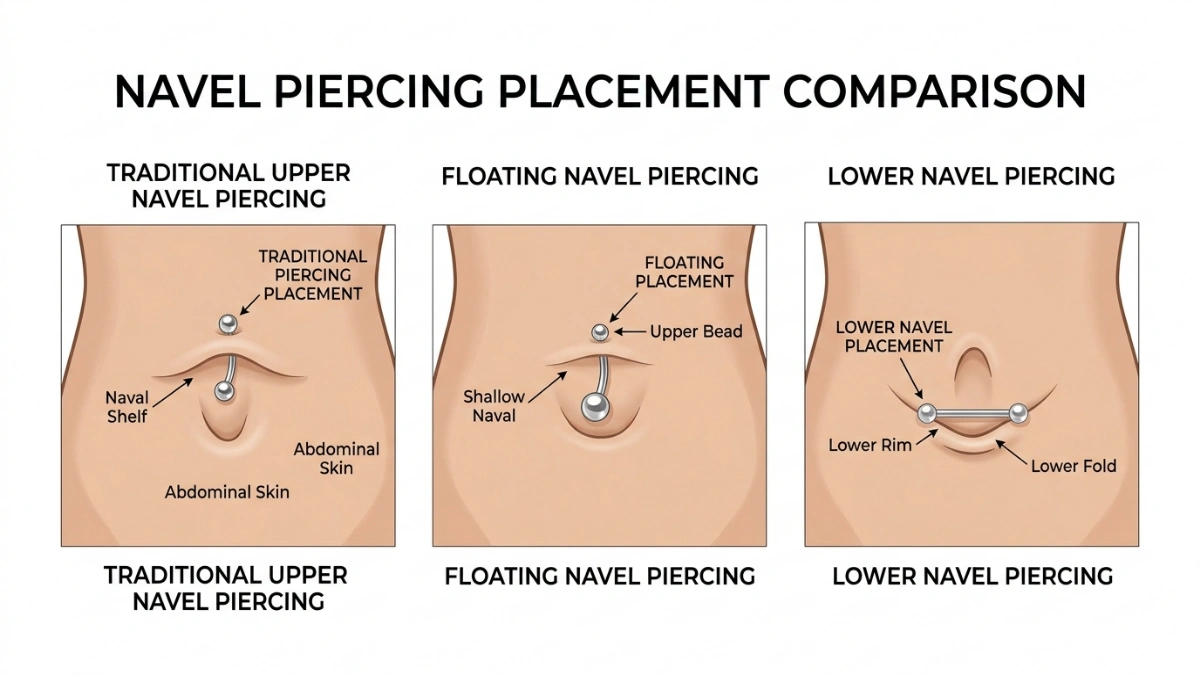
    Traditional Upper Belly Button Piercing

    Different navel piercing styles suit different anatomy. A piercing that works well for one person may not be suitable for someone with a shallow navel or a fold that presses against the jewelry.

    Traditional Upper Belly Button Piercing

    The traditional upper navel piercing passes through the upper rim of skin above the belly button.

    It is one of the most recognizable navel piercing styles and commonly uses a curved barbell with decorative ends. For example, you might choose a plain titanium piece for a minimalist appearance or a small gemstone for extra detail.

    This style works best when the upper rim has enough suitable tissue to support the jewelry without excessive pressure.

    Floating Navel Piercing

    A floating navel piercing uses jewelry designed to sit more comfortably when the lower part of the navel compresses during sitting or bending.

    Instead of a prominent lower bead, the jewelry often has a flatter bottom end. As a result, it may suit some people whose belly button folds inward when they sit.

    However, a floating navel piercing still requires suitable anatomy. A professional piercer should determine whether this style is appropriate for you.

    Lower Belly Button Piercing

    A lower or inverse navel piercing places the jewelry through the lower rim of the belly button rather than the upper rim.

    This placement creates a different look, especially with a decorative gemstone or curved barbell. Nevertheless, not everyone has enough suitable tissue in the lower rim, so an in person anatomy assessment is essential.

    Double Belly Button Piercing

    A double navel piercing combines two placements, often one above and one below the navel.

    The result can look symmetrical and distinctive. However, two piercings create two healing sites and require additional care. Your anatomy must support both placements safely, and a piercer may recommend starting with one instead.

    Belly Button Piercing Jewelry

    Belly Button Piercing Jewelry

    The right jewelry should suit your anatomy, skin sensitivity, and healing stage. Although decorative pieces can look appealing, the initial jewelry should prioritize fit, material quality, and comfort. The Association of Professional Piercers recommends suitable, high quality jewelry made from materials appropriate for fresh piercings.

    Popular Belly Button Jewelry Styles

    Jewelry StyleAppearanceBest Consideration
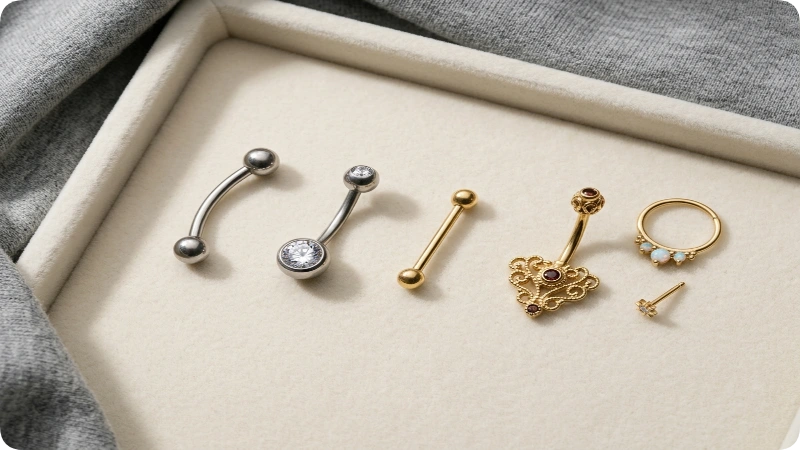
    Curved barbellCurved bar with decorative endsCommon choice for traditional navel piercings
    Gemstone barbellSmall crystals or gemstonesOffers a decorative, polished look
    Floating navel jewelryFlat lower end with a decorative topMay suit a navel that compresses when sitting
    Dangle jewelryHanging charms or stonesBetter reserved for a fully healed piercing
    Gold tone jewelryWarm golden appearanceCheck the actual metal and coating
    Minimalist barbellSimple, understated designUseful if you prefer a subtle look

    A curved barbell is a common starting point, but the best design depends on your anatomy and placement. In addition, heavy charms and dangling pieces can pull on healing tissue, so wait until the piercing has fully healed before using them.

    What Is the Safest Metal for a Belly Button Piercing?

    MaterialSuitabilityWhat to Check
    Implant grade titaniumStrong option for fresh piercingsConfirm the material meets an appropriate implant grade standard
    Suitable implant grade steelMay be appropriateVerify its specification, particularly if you have metal sensitivities
    Solid goldCan be suitableChoose biocompatible, nickel  and cadmium free gold of at least 14 karats
    Gold plated jewelryAvoid for a fresh piercingThe coating can wear away
    Unknown metal alloysAvoidComposition and potential allergens may be unclear

    Material quality matters because new piercing tissue is vulnerable to irritation. Therefore, ask the piercer to identify the jewelry’s material rather than relying on a label such as “hypoallergenic.”

    How Much Does a Belly Button Piercing Hurt?

    A belly button piercing usually causes a brief, sharp sensation when the needle passes through the tissue. You may then feel pressure, tenderness, or mild throbbing around the area.

    However, pain varies from person to person. Your sensitivity, anatomy, stress level, and the piercer’s technique can all influence the experience.

    What Happens During the Piercing Procedure?

    A professional piercing appointment typically follows these steps:

    1. Anatomy assessment: The piercer checks your navel and discusses suitable placement.
    2. Cleaning and marking: They clean the area and mark the proposed entry and exit points.
    3. Sterile preparation: They prepare the appropriate equipment and jewelry using safe procedures.
    4. Piercing: They perform the piercing with sterile, single use equipment.
    5. Jewelry placement: They insert suitable jewelry and explain how to care for the new piercing.

    Choose a professional who welcomes questions and explains each step. Avoid attempting to pierce your own navel because incorrect placement and nonsterile equipment can cause serious complications.

    Does a Belly Button Piercing Hurt More Than an Ear Piercing?

    There is no universal pain ranking. A navel piercing passes through different tissue from an earlobe piercing, and individual experiences vary. The procedure may feel more intense if you are anxious or if the area is particularly sensitive.

    Rather than judging the piercing by someone else’s pain score, ask an experienced piercer to explain the process and assess your anatomy.

    Belly Button Piercing Healing Time

    A navel piercing can take six months to a year or longer to heal fully. Some take longer, especially when clothing repeatedly rubs against the jewelry or the piercing experiences irritation.

    Belly Button Piercing Healing Stages

    StageWhat You May NoticeWhat to Do
    First few daysTenderness, mild swelling, or light bleedingClean gently and avoid pressure
    Early healingMild itching, crusting, and occasional tendernessContinue appropriate aftercare
    Ongoing healingThe outside may look better while internal tissue remains fragileKeep protecting the piercing
    Later healingLess tenderness and dischargeContinue care until fully healed
    Fully healedNo ongoing tenderness, crusting, or dischargeAsk a professional before changing jewelry if unsure

    These stages are approximate, not a guaranteed schedule. A piercing can look healed on the outside while the internal channel still needs time to recover.

    Can You Swim After Getting a Belly Button Piercing?

    Avoid submerging a fresh or healing piercing in swimming pools, hot tubs, lakes, oceans, and other bodies of water because they can expose the wound to microorganisms. Follow professional aftercare guidance until the piercing has healed.

    If swimming is unavoidable, ask a qualified piercer or healthcare professional about suitable protection. Do not assume that a waterproof covering removes all risks.

    Belly Button Piercing Aftercare

    Proper aftercare helps reduce irritation and supports healing. The goal is to keep the area clean without repeatedly disturbing the tissue.

    How to Clean a Belly Button Piercing

    Follow these basic steps, based on the Association of Professional Piercers’ guidance.

    1. Wash your hands thoroughly before touching the area.
    2. Spray the piercing with sterile saline wound wash containing 0.9% sodium chloride as the only active ingredient.
    3. Let the saline loosen any surface debris.
    4. Gently remove loosened crust without pulling or scraping the tissue.
    5. Pat the area dry with clean disposable gauze or another suitable disposable product.

    Do not twist, spin, or rotate the jewelry while cleaning. Also, avoid overcleaning because repeated friction and harsh products can delay healing.

    What Should You Avoid During Healing?

    AvoidWhy It Matters
    Alcohol and hydrogen peroxideCan irritate or damage healing tissue
    Twisting or playing with jewelryCreates friction and unnecessary trauma
    Tight waistbandsCan press against or snag the piercing
    Heavy charmsAdd weight and pulling force
    Lotions and fragranced productsMay irritate the piercing
    Swimming and soakingCan expose the wound to microorganisms
    Changing jewelry too earlyMay injure the healing channel

    Instead, wear clean, comfortable clothing that does not press on your navel. If a jewelry change becomes necessary during healing, ask a qualified piercer to assess and perform it.

    Belly Button Piercing Risks and Signs of Infection

    Like any piercing, a navel piercing can develop irritation, infection, an allergic reaction, scarring, or migration and rejection. Appropriate placement, suitable jewelry, and consistent aftercare can reduce some risks, but they cannot eliminate them.

    What Is Normal After a Belly Button Piercing?

    During early healing, you may notice:

    • Mild tenderness or localized swelling.
    • A small amount of bleeding or bruising.
    • Occasional itching.
    • Pale fluid that dries into a light crust.
    • Mild discoloration around the piercing.

    These symptoms should generally improve rather than become increasingly severe. However, healing times vary, and persistent or worsening symptoms deserve professional assessment.

    How to Recognize an Infected Belly Button Piercing

    Watch for warning signs such as:

    • Increasing pain, heat, or swelling.
    • Skin that becomes increasingly red or dark.
    • Thick yellow, green, or foul smelling discharge.
    • Fever, chills, or feeling generally unwell.
    • Red streaks extending from the piercing.

    If you suspect an infection, seek prompt medical care. Do not remove the jewelry yourself unless a healthcare professional advises you to do so, because removal can sometimes interfere with drainage or complicate an infection.

    What Is Piercing Rejection?

    Rejection occurs when the body gradually pushes the jewelry toward the skin’s surface. Migration means the jewelry changes position from its original placement.

    Signs can include:

    • Increasingly visible jewelry beneath thinning skin.
    • A piercing hole that appears to move.
    • A strip of skin between the entry and exit points that becomes thinner.
    • Persistent irritation or a change in the piercing’s angle.

    If you notice these changes, consult a qualified piercer promptly. Seek medical advice if the skin is breaking down, the area is painful, or infection is possible.

    Belly Button Piercing Cost

    The cost of a belly button piercing varies by location, studio, piercer experience, jewelry material, and whether the quoted fee includes aftercare or follow up appointments.

    What Affects the Price?

    Cost FactorWhy It Matters
    Piercing serviceExperienced professionals may charge more for their expertise
    Jewelry materialImplant grade titanium and quality solid gold differ in price
    Jewelry designGemstones and decorative details can increase the cost
    Studio hygieneProper sterilization and professional equipment are essential
    Follow up careSome studios include checkups or jewelry downsizing; others charge separately

    Do not choose a studio solely because it offers the lowest price. A safe procedure and correctly fitted jewelry matter more than a bargain.

    Because prices vary widely, contact reputable studios in your area for a current quote and ask what the fee includes.

    How to Choose a Professional Piercer

    A good piercer should assess your anatomy, explain the procedure, use appropriate sterilization practices, and provide clear aftercare instructions.

    Before booking, ask these questions:

    • Does the studio use sterile, single use needles?
    • Does the piercer open sterile equipment in front of clients?
    • Do they use an appropriate autoclave for reusable equipment?
    • Can they explain the material and quality of the initial jewelry?
    • Will they assess whether my navel anatomy suits the piercing?
    • Do they provide written aftercare guidance and follow up support?

    Also, observe the studio’s cleanliness and whether staff use clean gloves and handle equipment appropriately. The Association of Professional Piercers provides a useful guide for evaluating a piercing studio.

    Frequently Asked Questions About Belly Button Piercing

    1. How long does a belly button piercing take to heal?

    A belly button piercing commonly takes six months to a year or longer to heal fully. Friction, unsuitable jewelry, and repeated irritation can extend the process. Do not assume it has healed just because it looks normal.

    2. Can you get a belly button piercing if you have a small belly button?

    Possibly. The size of your navel alone does not determine suitability. A professional piercer should assess the available tissue, the shape of the navel, and how the area folds when you sit or bend.

    3. Is a belly button piercing painful?

    Most people experience a brief sharp sensation followed by tenderness. However, pain varies with individual sensitivity, anatomy, anxiety, and technique.

    4. When can you change belly button piercing jewelry?

    Wait until the piercing has fully healed before changing jewelry for appearance. Because healing can take a year or longer, ask a qualified piercer to assess readiness. If the jewelry needs adjustment during healing, have a professional handle it.

    5. Can you sleep on your stomach with a new belly button piercing?

    Pressure and friction from sleeping on your stomach may irritate a new piercing. Try a position that avoids direct pressure on the navel, especially during early healing.

    6. Can you exercise with a belly button piercing?

    Gentle exercise may be possible, but avoid activities that repeatedly pull, press, or snag the jewelry. Clean equipment and clothing that does not rub against the piercing can help reduce irritation.

    7. Can you swim with a new belly button piercing?

    It is best to avoid swimming and submerging a healing piercing in pools, hot tubs, lakes, and oceans. These environments can expose the wound to microorganisms, so wait until it has healed.

    8. What jewelry is best for a new belly button piercing?

    A properly fitted curved barbell made from verified implant grade titanium is a common option. The piercer should select the appropriate size and style for your anatomy rather than choosing jewelry based on appearance alone.

    9. Why does my belly button piercing smell?

    A healed piercing can accumulate normal skin oils, dead skin cells, and secretions that cause an odor. Gentle routine cleaning may help. However, a strong foul smell accompanied by pain, swelling, heat, or unusual discharge needs medical assessment.

    10. Can a belly button piercing leave a scar?

    Yes. Even after the jewelry is removed and the hole closes, a small mark or scar may remain. Migration, rejection, infection, and individual healing characteristics can increase the likelihood of noticeable scarring.

    Key Takeaways

    • A belly button piercing should suit your anatomy, not just your preferred style.
    • Traditional upper, floating, lower, and double navel piercings offer different placements.
    • Full healing commonly takes six months to a year or longer.
    • Choose suitable, high quality jewelry and follow gentle saline aftercare.
    • Avoid pressure, harsh cleaning products, premature jewelry changes, and swimming during healing.
    • Seek prompt medical care if you notice signs of infection.

    Conclusion

    A belly button piercing can be a stylish form of self expression, whether you prefer a minimalist curved barbell or a decorative gemstone. However, choosing a reputable piercer, selecting suitable jewelry, and allowing enough time for healing are essential parts of the process.

    Before booking an appointment, have a professional assess your navel anatomy and explain the risks, aftercare, and likely costs. With realistic expectations and consistent care, you can make a more informed decision about whether a navel piercing suits you.
  • 50+ Ear Piercing Names: Types, Placements, Pain & Healing Guide

    50+ Ear Piercing Names: Types, Placements, Pain & Healing Guide

    Feature Snippet:

    If you are searching for ear piercing names, you have probably noticed that ear piercings have many different names depending on where the jewelry sits. A classic lobe piercing looks very different from a helix, tragus, conch, rook, or daith piercing. Understanding these names makes it easier to describe the style you want, compare placements, and discuss jewelry options with a professional piercer. It can also help you understand why some piercings generally heal faster than others.

    The earlobe is made from softer tissue and usually heals faster, while cartilage piercings tend to require a much longer healing period. Cleveland Clinic notes that lobe piercings commonly heal in about six to eight weeks, while several cartilage placements can take six months to a year.

    Table of Contents

    SectionWhat You’ll Learn
    Ear Piercing NamesThe most common types and their locations
    Lobe PiercingsStandard, upper, stacked, and related lobe styles
    Cartilage PiercingsHelix, forward helix, conch, tragus, and more
    Inner Ear PiercingsRook and daith placements
    Industrial PiercingHow the two hole barbell style works
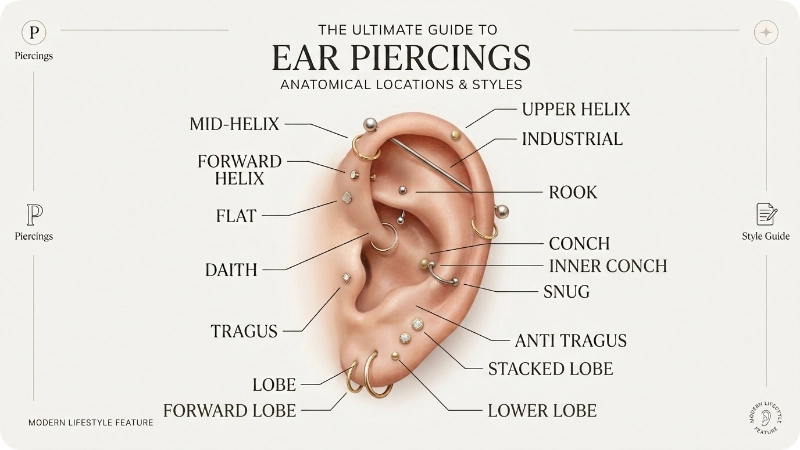
    Ear Piercing PlacementWhere each type sits
    Pain and HealingWhat can affect discomfort and healing
    Beginner Friendly PiercingsOptions commonly considered easier to start with
    Piercing CombinationsIdeas for creating an ear stack
    Choosing a PiercingFactors to consider before booking
    FAQsAnswers to common ear piercing questions

    Ear Piercing Names and Their Meanings

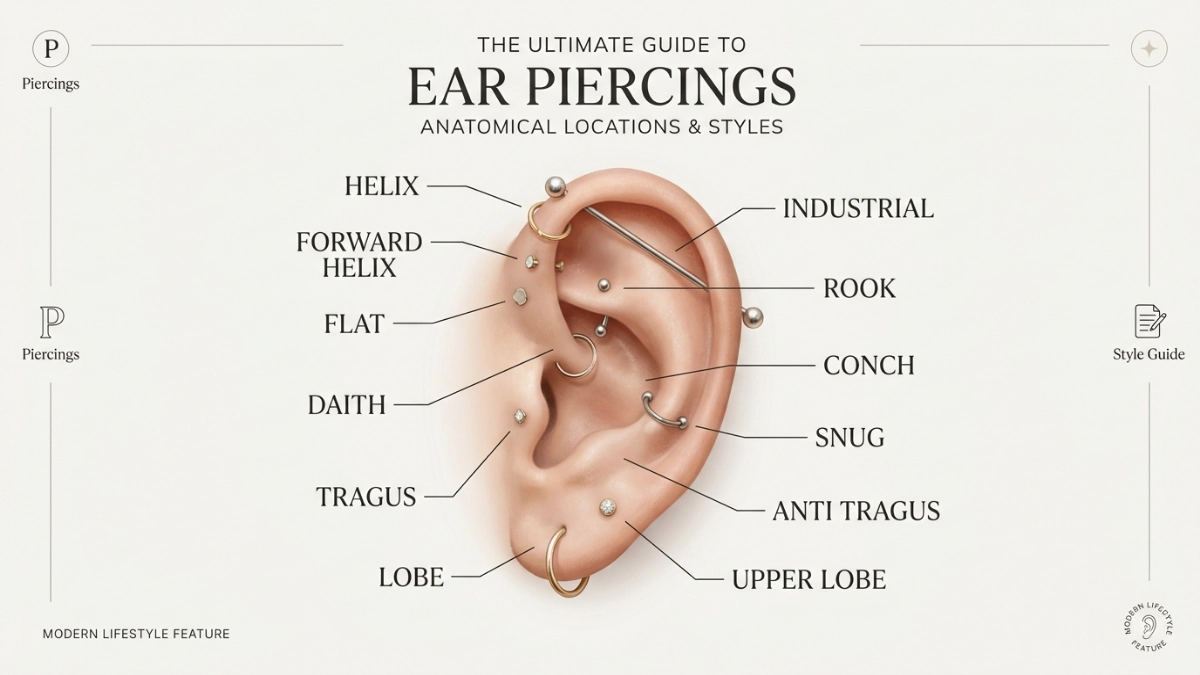
    The name of an ear piercing usually describes the part of the ear where the jewelry passes through. For example, a helix piercing goes through the upper outer cartilage, while a tragus piercing goes through the small cartilage area in front of the ear canal.

    Here are some of the most commonly recognized names:

    Ear PiercingGeneral PlacementTissue
    LobeLower fleshy partSoft tissue
    Upper LobeHigher section of lobeSoft tissue
    Stacked LobeMultiple lobe placementsSoft tissue
    HelixUpper outer rimCartilage
    Forward HelixFront upper cartilageCartilage
    FlatFlat upper ear areaCartilage
    TragusSmall cartilage in front of ear canalCartilage
    Anti TragusCartilage opposite tragusCartilage
    ConchInner cup of earCartilage
    RookUpper inner cartilage foldCartilage
    DaithInner cartilage fold above ear canalCartilage
    SnugInner cartilage foldCartilage
    IndustrialTwo upper cartilage holes connected by barCartilage

    Exact anatomy and suitability can vary from ear to ear, so a professional piercer should assess your individual ear before deciding whether a particular placement is appropriate.

    Lobe Piercing Names

    Lobe Piercing Names

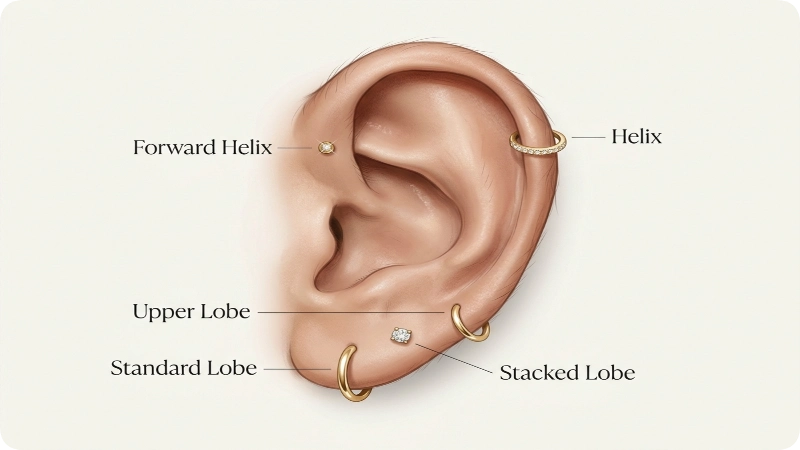
    The lobe piercing is the classic ear piercing placed through the soft lower portion of the ear. It is one of the most common ear piercing choices and generally heals faster than cartilage piercings.

    Standard Lobe Piercing

    A standard lobe piercing sits in the lower fleshy portion of the ear. Many people start with this placement because it accommodates a wide variety of earrings.

    Upper Lobe Piercing

    An upper lobe piercing sits higher on the earlobe. It can create a layered appearance when combined with a standard lobe piercing.

    Stacked Lobe Piercings

    A stacked lobe arrangement uses multiple piercings positioned vertically or diagonally across the lobe. The exact arrangement depends on the available anatomy and desired jewelry combination.

    Lobe StyleLookJewelry Ideas
    Standard lobeClassicStuds, hoops
    Upper lobeLayeredSmall studs, tiny hoops
    Double lobeCoordinatedMatching studs
    Triple lobeMore decorativeMixed studs and hoops
    Stacked lobeArtisticSmall mixed jewelry

    Cartilage Ear Piercing Names

    Cartilage Ear Piercing Names

    Cartilage piercings create many of the distinctive ear piercing styles seen in modern ear stacks. Popular examples include the helix, forward helix, tragus, conch, and flat piercing.

    Because cartilage has less blood supply than soft tissue, it generally takes longer to heal. Cleveland Clinic estimates that cartilage piercings may take up to six months or even a year to fully heal.

    Helix Piercing

    A helix piercing goes through the cartilage along the upper outer edge of the ear. It is one of the most recognizable cartilage piercings.

    You can also have multiple helix piercings along the outer rim to create a layered arrangement.

    Forward Helix Piercing

    A forward helix sits toward the front of the upper ear, closer to where the ear meets the head. Its position creates a different look from a traditional helix.

    Flat Piercing

    A flat piercing is placed through the relatively flat cartilage area on the upper part of the ear. Decorative studs often work particularly well with this placement.

    Tragus Piercing

    The tragus is the small piece of cartilage positioned immediately in front of the ear canal. A tragus piercing passes through this cartilage.

    Because the placement is close to the ear canal, professional placement and suitable jewelry are especially important.

    Conch Piercing

    A conch piercing sits in the cup shaped central area of the ear. The name comes from the ear’s resemblance to a conch shell. Both inner and outer conch placements are used.

    Cartilage PiercingWhere It SitsOverall Look
    HelixUpper outer rimClassic and versatile
    Forward helixFront upper cartilageDelicate
    FlatUpper flat cartilageMinimal
    TragusIn front of ear canalSubtle
    ConchCentral ear cupBold but refined
    Anti tragusOpposite tragusUnusual
    SnugInner cartilage foldDistinctive

    Inner Ear Piercing Names

    Inner Ear Piercing Names

    Some ear piercing names refer to cartilage folds deeper inside the visible outer ear. Two particularly recognizable examples are the rook and daith.

    Rook Piercing

    A rook piercing passes through the inner edge of the upper cartilage ridge. It sits above the daith area and can create a distinctive curved jewelry look.

    Not every ear has anatomy suitable for a rook piercing, so a professional assessment matters.

    Daith Piercing

    A daith piercing passes through a fold of cartilage near the entrance to the ear canal. The location is relatively thick and curved.

    You may see claims online that daith piercings can prevent migraines. However, current medical evidence does not establish ear piercing as a migraine treatment. Cleveland Clinic specifically notes that there is no scientific evidence that daith or other ear piercings prevent migraines.

    Industrial Ear Piercing

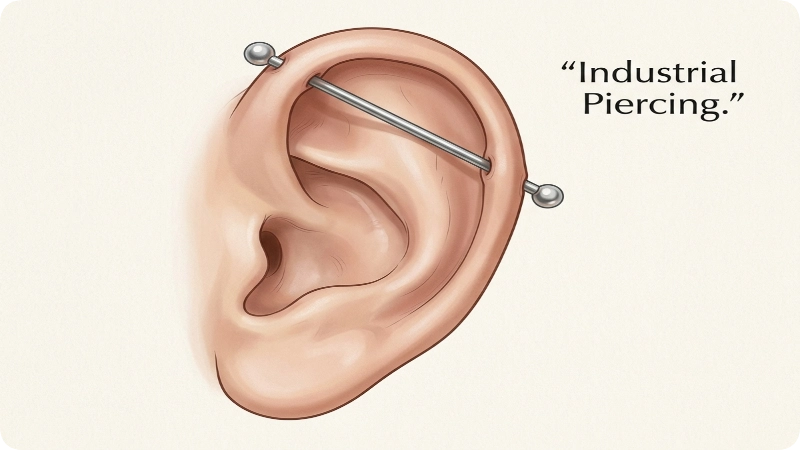
    An industrial piercing typically involves two piercings connected by one barbell. It commonly crosses the upper cartilage of the ear.

    Because an industrial piercing involves two healing sites connected by jewelry, it requires careful placement and aftercare. Ear anatomy also plays an important role in determining whether the traditional barbell configuration is suitable.

    Industrial Piercing at a Glance

    FeatureIndustrial Piercing
    Number of holesUsually two
    JewelryConnecting barbell
    Typical areaUpper ear cartilage
    StyleBold and structured
    TissueCartilage
    HealingLonger than lobe piercing
    AnatomyMust be assessed individually

    Ear Piercing Placement Chart

    Knowing the placement names can make it easier to visualize an ear piercing combination.

    Area of EarCommon Piercing Names
    Lower lobeLobe
    Upper lobeUpper lobe
    Outer upper rimHelix
    Front upper rimForward helix
    Upper flat areaFlat
    Central cupConch
    Front of ear canalTragus
    Inner upper foldRook
    Inner fold near canalDaith
    Opposite tragusAnti tragus
    Inner cartilage foldSnug
    Upper cartilage bridgeIndustrial

    The exact location can vary slightly between piercers and individual ear anatomy. For that reason, names are useful for communicating an idea, but a professional should determine the final placement.

    Which Ear Piercing Hurts the Least?

    Pain varies from person to person. Your individual pain tolerance, anatomy, piercing location, technique, and jewelry can all influence the experience.

    Generally, the earlobe tends to be less uncomfortable than thicker cartilage placements. Healthline also notes that cartilage piercings such as the daith, rook, and conch can be more uncomfortable than softer ear tissue.

    Instead of relying on a universal pain ranking, consider the type of tissue involved.

    Piercing AreaGeneral Consideration
    EarlobeSofter tissue; usually easier to heal
    Upper lobeStill primarily soft tissue
    HelixCartilage; longer healing
    TragusCartilage near ear canal
    ConchThicker cartilage
    RookFirm cartilage fold
    DaithThick inner cartilage
    IndustrialTwo cartilage piercing sites

    Ear Piercing Healing Times

    Healing times vary significantly. Your anatomy, jewelry, aftercare, irritation, and overall healing response can affect the process.

    Cleveland Clinic reports that earlobe piercings tend to heal in around six to eight weeks, while cartilage piercings such as the helix, tragus, conch, rook, and daith may take six months to a year.

    TypeGeneral Healing Consideration
    LobeUsually faster
    Upper lobeGenerally faster than cartilage
    HelixLonger healing period
    Forward helixLonger healing period
    TragusLonger healing period
    ConchLonger healing period
    RookLonger healing period
    DaithLonger healing period
    IndustrialExtended cartilage healing

    These are general ranges rather than guarantees. A piercing should not be treated as fully healed simply because a minimum time period has passed.

    Best Ear Piercings for Beginners

    Best Ear Piercings for Beginners

    If this is your first piercing beyond a standard lobe, you may want to consider how easy the placement will be to protect and care for.

    A lobe piercing is generally simpler to heal than cartilage because it involves softer tissue and usually heals faster.

    For a beginner considering cartilage, discuss your anatomy, lifestyle, sleeping habits, headphones, helmets, hair, and jewelry preferences with a reputable professional piercer.

    Beginner Considerations

    • Start with a placement that fits your anatomy.
    • Consider whether you regularly sleep on that side.
    • Think about whether headphones will touch the piercing.
    • Choose appropriate initial jewelry with your piercer.
    • Be prepared for cartilage to heal more slowly.
    • Avoid changing jewelry before the piercing has adequately healed.

    Popular Ear Piercing Combinations

    Once you understand the individual names, you can combine different placements to create an ear stack or curated ear look.

    Minimal Ear Stack

    A simple combination might include:

    • Standard lobe
    • Upper lobe
    • Small helix

    This creates a layered look without filling the entire ear.

    Classic Ear Stack

    Try combining:

    • First lobe
    • Second lobe
    • Helix
    • Conch

    Small hoops and studs can create a balanced arrangement.

    Bold Ear Stack

    For a more dramatic arrangement, you might consider:

    • Multiple lobe piercings
    • Helix
    • Forward helix
    • Conch
    • Tragus
    • Industrial

    However, more piercings also mean more healing sites and more aftercare. A professional piercer can help determine whether the combination makes sense for your anatomy and whether the placements should be done at the same time or spaced apart.

    How to Choose the Right Ear Piercing

    Consider Your Ear Anatomy

    Not every ear can accommodate every piercing. The shape, size, folds, and cartilage structure of your ear influence which placements are suitable.

    Think About Your Lifestyle

    If you frequently wear headphones, helmets, glasses, or other equipment that touches your ear, some placements may be more convenient than others.

    Consider Your Sleeping Position

    A fresh cartilage piercing can become irritated when you repeatedly put pressure on it. If you usually sleep on one side, discuss placement options with your piercer.

    Choose Appropriate Jewelry

    Your professional piercer can recommend jewelry based on the location, anatomy, and stage of healing. Cleveland Clinic lists titanium, medical grade steel, and 14K gold among commonly recommended options and advises avoiding metals such as nickel if you have sensitivities.

    Choose a Qualified Piercer

    A professional should use appropriate sterile equipment and evaluate your anatomy before piercing. Piercing procedures can carry risks including infection, allergic reactions, and scarring or keloids.

    Ear Piercing Aftercare Basics

    A new piercing is a healing wound, so aftercare matters.

    Keep the area clean according to the instructions provided by your professional piercer. Avoid unnecessary touching, twisting, or irritating the jewelry, and protect the piercing from repeated friction.

    Watch for symptoms such as increasing redness, swelling, pain, or discharge. If you suspect an infection or have symptoms that concern you, seek medical advice rather than relying solely on home remedies.

    Do not change jewelry simply because the piercing looks healed on the outside. The deeper tissue may still be healing, particularly with cartilage piercings.

    Frequently Asked Questions About Ear Piercing Names

    What are the main ear piercing names?

    Common ear piercing names include lobe, upper lobe, helix, forward helix, flat, tragus, conch, rook, daith, anti tragus, snug, and industrial.

    What is the most common ear piercing?

    The earlobe piercing is one of the most common ear piercings. The earlobe contains softer tissue and generally heals faster than cartilage placements.

    What is a helix piercing?

    A helix piercing goes through the cartilage along the upper outer edge of the ear. It is one of the most recognizable cartilage piercing styles.

    What is a tragus piercing?

    A tragus piercing passes through the small cartilage section positioned in front of the ear canal.

    What is a conch piercing?

    A conch piercing goes through the cup shaped central area of the ear. It can be placed in the inner or outer conch area depending on anatomy and desired placement.

    What is a rook piercing?

    A rook piercing goes through an inner cartilage ridge in the upper portion of the ear. The exact suitability depends on the individual’s ear anatomy.

    What is a daith piercing?

    A daith piercing passes through a fold of cartilage near the entrance to the ear canal. Although some people claim that it helps with migraines, scientific evidence does not support ear piercing as a migraine treatment.

    What is an industrial piercing?

    An industrial piercing usually consists of two holes in the upper ear cartilage connected by a single barbell.

    Which ear piercing heals the fastest?

    Lobe piercings generally heal faster than cartilage piercings. Cleveland Clinic gives a typical healing period of about six to eight weeks for earlobes, while cartilage piercings can take six months to a year.

    How do I choose the right ear piercing?

    Consider your ear anatomy, desired appearance, lifestyle, sleeping habits, headphones or other equipment, jewelry preferences, and willingness to manage a longer healing period. A reputable professional piercer can assess your ear and recommend suitable placements.

    Key Takeaways

    • Lobe, helix, tragus, conch, rook, daith, and industrial are some of the best known ear piercing names.
    • Lobe piercings use softer tissue and generally heal faster than cartilage piercings.
    • Helix piercings sit along the upper outer ear.
    • Tragus piercings sit in the cartilage immediately in front of the ear canal.
    • Conch piercings sit in the central cup of the ear.
    • Rook and daith piercings use inner cartilage folds.
    • Industrial piercings typically connect two cartilage holes with one barbell.
    • Individual anatomy determines whether a particular piercing is suitable.
    • Cartilage piercings generally require much more patience during healing.
    • Daith piercings should not be considered a proven treatment for migraines.
    • Professional assessment and appropriate aftercare can help reduce piercing related complications.

    Conclusion

    Learning the different ear piercing names makes it much easier to choose and describe the style you want. From the classic lobe and elegant helix to the distinctive conch, tragus, rook, daith, and industrial, each placement creates a different look and involves different anatomy.

    If you are planning a new piercing, focus on more than appearance. Consider your ear anatomy, lifestyle, jewelry preferences, healing requirements, and aftercare routine. Most importantly, work with a qualified professional who can assess the specific placement and explain what is appropriate for your ear.

  • Lip Piercing Names: Guide to Lip Piercing Types and Styles

    Lip Piercing Names: Guide to Lip Piercing Types and Styles

    Feature Snippet:

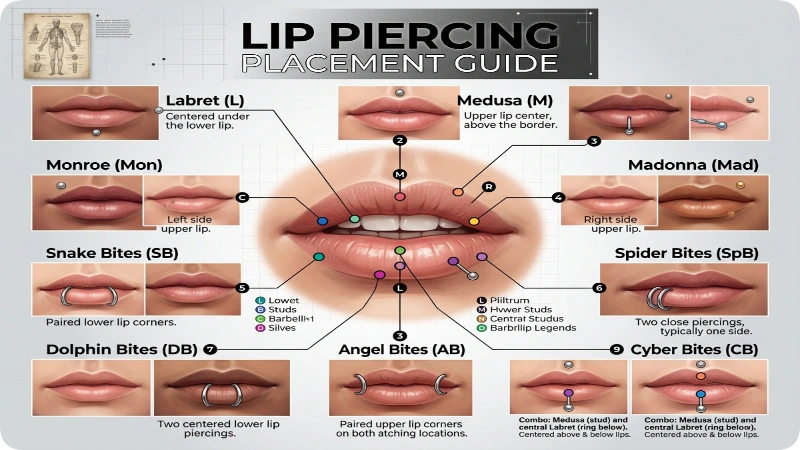
    Lip piercings come in many styles, and each one has a different name based mainly on its placement, direction, or combination with other piercings. Some styles sit below the lower lip, while others appear above the upper lip or pass vertically through the lip. If you are researching lip piercing names, understanding the terminology can make it much easier to identify the style you like. For example, a Labret sits below the center of the lower lip, while a Medusa sits in the center above the upper lip. Meanwhile, Snake Bites use two piercings, one on each side of the lower lip.

    This guide explains the most common lip piercing names, their placement, typical jewelry styles, and the differences between similar looking piercings.

    Safety note: Lip and other oral piercings can cause swelling, bleeding, infection, gum recession, chipped or damaged teeth, and other oral complications. The American Dental Association advises against cosmetic intraoral and perioral piercing because of these potential risks.

    Table of Contents

    SectionWhat You’ll Learn
    Types of Lip PiercingsThe main names and placements
    Labret PiercingsDifferent Labret styles
    Upper Lip PiercingsMonroe, Madonna, Medusa, and Jestrum
    Double Lip PiercingsSnake Bites, Spider Bites, and similar styles
    Four Piercing StylesShark Bites and Canine Bites
    Lip Piercing ComparisonHow the main styles differ
    Choosing a Lip PiercingFactors to consider
    Aftercare and RisksBasic care and potential complications
    FAQsAnswers to common questions
    Key TakeawaysQuick summary of the guide

    What Are Lip Piercing Names?

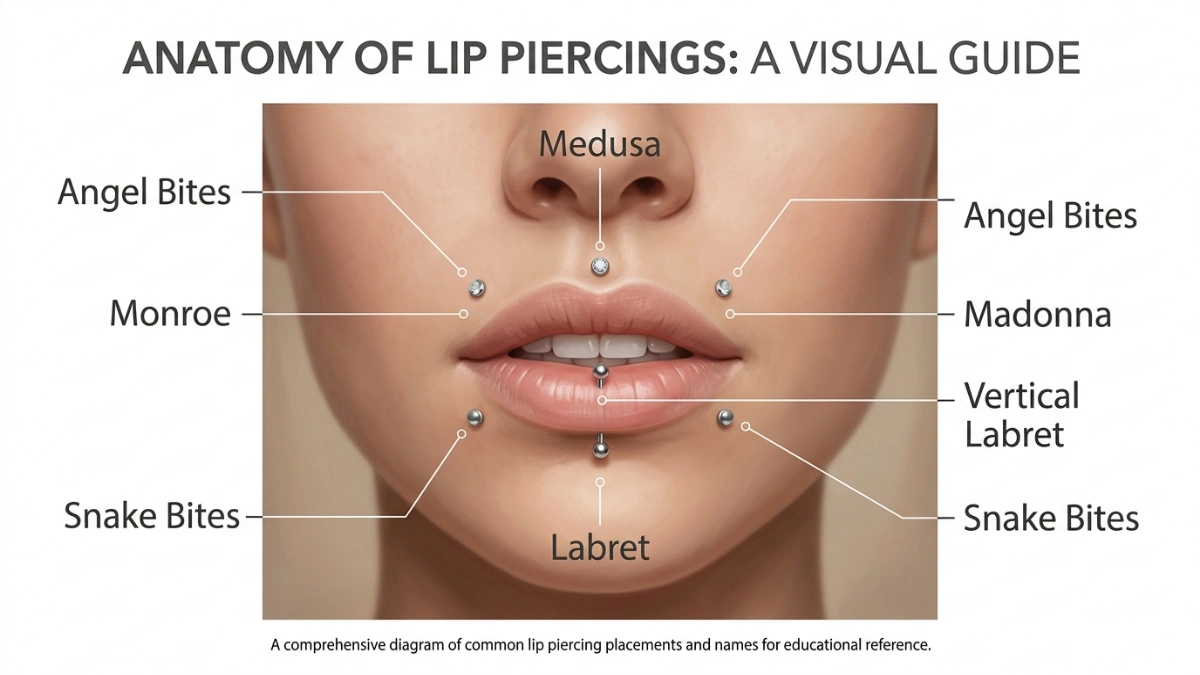
    Lip piercing names describe different piercing placements around the lips and mouth. The names can refer to the exact location, the number of piercings, or the arrangement of the jewelry.

    For instance, a Labret normally refers to a centered piercing below the lower lip. In contrast, a Monroe and Madonna sit above the upper lip on opposite sides.

    Some names also describe combinations. Snake Bites have two lower lip piercings, while Angel Bites use two upper lip piercings.

    Because piercing terminology can vary between studios and communities, two piercers may occasionally use slightly different names for a similar placement.

    Most Popular Lip Piercing Names

    Most Popular Lip Piercing Names

    Here are some of the best known lip piercing styles:

    Lip PiercingGeneral PlacementTypical Configuration
    LabretCenter below lower lipSingle
    Vertical LabretThrough lower lip verticallySingle
    AshleyCenter of lower lipSingle
    MonroeOne side above upper lipSingle
    MadonnaOpposite side above upper lipSingle
    MedusaCenter above upper lipSingle
    JestrumVertical upper lip placementSingle
    Snake BitesBoth sides of lower lipDouble
    Spider BitesTwo close piercings on one sideDouble
    Dolphin BitesTwo close lower center piercingsDouble
    Angel BitesBoth sides of upper lipDouble
    Shark BitesTwo on each side of lower lipFour
    Canine BitesUpper and lower lip combinationsFour
    Cyber BitesMedusa + Labret combinationDouble

    These terms describe common piercing configurations, although naming conventions can differ between professional piercers.

    Labret Piercing

    Labret Piercing

    The Labret is one of the classic lip piercing styles. It usually sits in the center below the lower lip.

    A traditional Labret uses jewelry that passes through the lower lip area, with the visible end appearing below the lip and the backing positioned inside the mouth.

    Vertical Labret

    The Vertical Labret creates a different look because the jewelry travels vertically through the lower lip. Unlike a traditional Labret, both ends of the jewelry can remain visible externally.

    This style can create a more prominent lip focused appearance while avoiding an internal backing that rests against the gums.

    Ashley Piercing

    The Ashley piercing is generally described as a single piercing through the center of the lower lip, with the jewelry appearing primarily on the front of the lip.

    Because terminology varies among piercing professionals, it is worth showing your piercer a reference image rather than relying only on the name.

    Upper Lip Piercing Names

    Upper Lip Piercing Names

    Several popular styles sit above or through the upper lip.

    Monroe Piercing

    The Monroe piercing sits above the upper lip on one side. Its name references the beauty mark look associated with Marilyn Monroe.

    The traditional placement appears on the left side of the upper lip.

    Madonna Piercing

    The Madonna piercing resembles the Monroe but appears on the opposite side of the upper lip.

    This creates a simple way to distinguish the two:

    StyleGeneral Position
    MonroeUpper lip, left side
    MadonnaUpper lip, right side
    MedusaCenter above upper lip
    JestrumVertical upper lip placement

    Placement conventions can vary, so confirm the intended location with your piercer before the procedure.

    Medusa Piercing

    The Medusa piercing, also called a philtrum piercing, sits in the center above the upper lip, in the philtrum area.

    Its centered placement gives it a symmetrical appearance and makes it visually different from the side positioned Monroe and Madonna.

    Jestrum Piercing

    The Jestrum is a vertical upper lip piercing. It is sometimes described as a vertical variation of the Medusa because the jewelry follows a vertical path through the upper lip area.

    It usually creates two visible ends, making it easy to distinguish from a standard Medusa.

    Double Lip Piercing Names

    Double Lip Piercing Names

    If you want two piercings instead of one, several established names describe different arrangements.

    Snake Bites

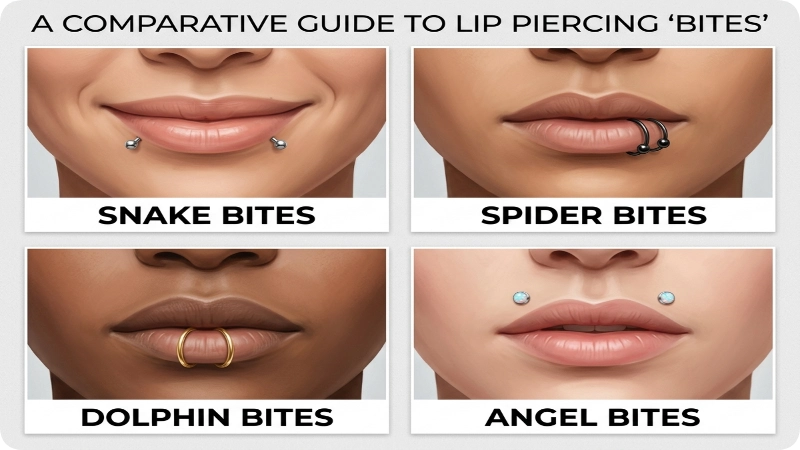
    Snake Bites consist of two lower lip piercings, with one positioned on each side.

    The symmetrical arrangement creates a bold look around the lower lip. Depending on the jewelry and healed placement, people may use studs or other jewelry styles.

    Spider Bites

    Spider Bites consist of two closely positioned piercings on one side of the lower lip.

    The key difference is their location:

    • Snake Bites = one piercing on each side
    • Spider Bites = two close piercings on one side

    Dolphin Bites

    Dolphin Bites generally refer to two closely spaced piercings positioned near the center of the lower lip.

    They resemble a more centralized version of a double lower lip arrangement.

    Angel Bites

    Angel Bites use two upper lip piercings, with one on each side.

    They create a symmetrical appearance similar to Snake Bites, but the piercings sit above the upper lip rather than around the lower lip.

    Four Lip Piercing Names

    Some styles combine multiple piercings for a more dramatic arrangement.

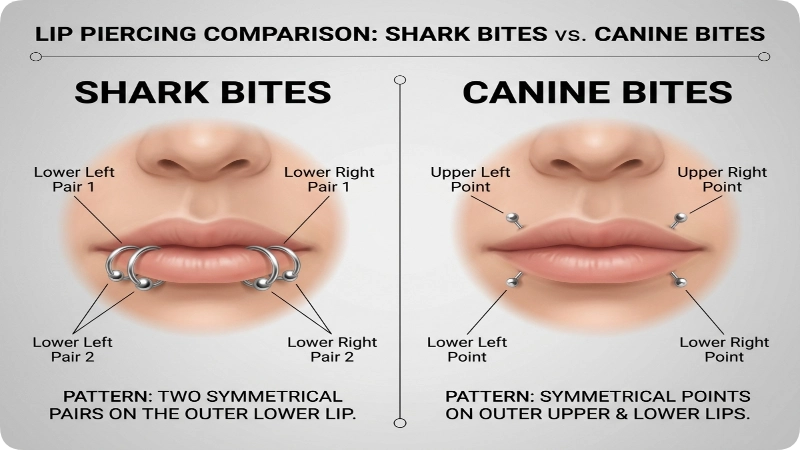
    Shark Bites

    Shark Bites generally consist of four lower lip piercings: two on the left and two on the right.

    The paired arrangement on both sides creates a more substantial look than Snake Bites.

    Canine Bites

    Canine Bites generally combine upper  and lower lip placements. They are commonly described as a combination of Angel Bites and Snake Bites, creating four piercings around the mouth.

    Because four piercings require several healing sites, professional placement and appropriate jewelry sizing become especially important.

    Cyber Bites

    Cyber Bites combine a centered upper lip Medusa with a centered lower lip Labret.

    The result creates a vertical alignment around the mouth.

    This arrangement differs from Snake Bites because both piercings sit on the center line rather than on the left and right sides.

    Lip Piercing Names by Placement

    If you already know where you want the piercing, the following guide can make your choice easier.

    Desired PlacementPiercing Names to Explore
    Center below lower lipLabret
    Vertically through lower lipVertical Labret
    Center of lower lipAshley
    Left side above upper lipMonroe
    Right side above upper lipMadonna
    Center above upper lipMedusa
    Vertical upper lipJestrum
    Both sides of lower lipSnake Bites
    Two close piercings on one sideSpider Bites
    Two near lower lip centerDolphin Bites
    Both sides of upper lipAngel Bites
    Four lower lip piercingsShark Bites
    Four upper/lower lip piercingsCanine Bites
    Upper and lower centerCyber Bites

    Labret vs Medusa vs Monroe

    These three names can easily become confusing because they all involve the area around the mouth.

    PiercingMain LocationArrangement
    LabretBelow lower lipCentered
    MedusaAbove upper lipCentered
    MonroeAbove upper lipOff center
    MadonnaAbove upper lipOff center, opposite side
    Vertical LabretThrough lower lipVertical

    The easiest distinction is the location. A Labret sits below the lower lip, a Medusa sits centrally above the upper lip, and a Monroe or Madonna sits off center above the upper lip.

    Snake Bites vs Spider Bites vs Shark Bites

    These names describe different multi piercing patterns.

    Snake Bites use two piercings, one on each side of the lower lip.

    Spider Bites use two closely spaced piercings on one side.

    Shark Bites use four lower lip piercings, with two on each side.

    StyleNumber of PiercingsGeneral Pattern
    Snake Bites2One on each side
    Spider Bites2Two close together on one side
    Shark Bites4Two on each side
    Dolphin Bites2Close together near center
    Angel Bites2One on each side of upper lip
    Canine Bites4Upper + lower combinations

    How to Choose a Lip Piercing

    Choosing a lip piercing involves more than deciding which style looks attractive. Placement, anatomy, jewelry, healing, and oral health all matter.

    Consider Your Anatomy

    Not every placement works equally well for every person. A professional piercer should assess your anatomy before deciding on the exact position.

    The Association of Professional Piercers notes that traditional lip and cheek piercing placement should account for how the jewelry sits inside the mouth and should avoid unnecessary contact with teeth and gums.

    Think About Your Jewelry

    Different styles can use different jewelry configurations. A professional piercer can recommend appropriate initial jewelry based on the location and expected swelling.

    Once swelling decreases, the original longer jewelry may need to be replaced with a shorter piece. This process is commonly called downsizing and can help reduce contact with teeth and gums.

    Consider Your Lifestyle

    Think about school, work, sports, photography, and other activities before choosing a visible facial piercing.

    You should also consider whether you are comfortable maintaining an oral piercing during its healing period.

    Lip Piercing Jewelry

    Common jewelry for oral and perioral piercings includes studs, barbells, rings, and hoops. The appropriate style depends on the piercing placement and healing stage.

    Jewelry TypeCommon Use
    Labret StudMany lip placements
    Curved BarbellSome vertical placements
    HoopOften considered after healing
    RingSome healed lip piercings
    Flat Back StudCommon for several lip placements

    Your piercer should select jewelry that suits your anatomy and the specific piercing rather than choosing solely based on appearance.

    Lip Piercing Aftercare

    Proper aftercare helps reduce irritation and supports healing.

    The Association of Professional Piercers recommends maintaining good oral hygiene for oral piercings. It also recommends using an alcohol free, hydrogen peroxide free mouth rinse and keeping the external portion clean with appropriate sterile saline.

    Basic aftercare includes:

    • Wash your hands before touching the piercing.
    • Maintain normal oral hygiene.
    • Brush your teeth with a soft bristled toothbrush.
    • Use an appropriate alcohol free mouth rinse.
    • Clean the external portion according to professional aftercare instructions.
    • Avoid playing with or twisting the jewelry.
    • Avoid unnecessary trauma to the piercing.
    • Return to your piercer for jewelry downsizing when appropriate.
    • Avoid oral contact during the initial healing period.
    • Follow the specific instructions provided by your professional piercer.

    The APP also recommends avoiding harsh products such as alcohol or hydrogen peroxide on a healing oral piercing because they can irritate the tissue.

    Are Lip Piercings Safe?

    Lip piercings involve risks because the jewelry can interact with both external tissue and the mouth.

    The American Dental Association reports potential complications including infection, swelling, bleeding, gum recession, tooth damage, scarring, embedded jewelry, and other oral problems.

    The position and jewelry fit matter because repeated contact with the teeth or gums can contribute to damage over time. The ADA therefore advises against cosmetic intraoral and perioral piercing.

    If you notice significant swelling, severe pain, unusual discharge, persistent bleeding, or other concerning symptoms, seek appropriate medical or dental care rather than trying to treat a potentially serious complication yourself.

    How Long Does a Lip Piercing Take to Heal?

    Healing varies according to the individual, piercing location, jewelry, placement, and aftercare.

    A piercing can appear healed externally before the internal tissue has completely recovered. The Association of Professional Piercers specifically notes that piercings can heal from the outside inward, so an apparently comfortable piercing may still have fragile internal tissue.

    For that reason, avoid changing jewelry prematurely and follow your professional piercer’s instructions.

    Which Lip Piercing Looks Most Subtle?

    A single centered or side positioned stud generally creates a simpler appearance than a multi piercing arrangement.

    For example, a Labret, Monroe, Madonna, or Medusa uses one piercing, while Snake Bites and Shark Bites create more noticeable multi piercing arrangements.

    However, the final appearance also depends on jewelry size, color, shape, and individual anatomy.

    Which Lip Piercings Use Two Piercings?

    Several popular styles use two piercings:

    • Snake Bites
    • Spider Bites
    • Dolphin Bites
    • Angel Bites

    The difference comes mainly from their placement.

    Snake Bites appear on opposite sides of the lower lip, while Spider Bites sit close together on one side. Angel Bites appear on opposite sides of the upper lip.

    10 Frequently Asked Questions About Lip Piercing Names

    What are the main lip piercing names?

    The main names include Labret, Vertical Labret, Ashley, Monroe, Madonna, Medusa, Jestrum, Snake Bites, Spider Bites, Dolphin Bites, Angel Bites, Shark Bites, Canine Bites, and Cyber Bites.

    What is the piercing under the lower lip called?

    The classic centered piercing below the lower lip is called a Labret.

    What is the piercing above the upper lip called?

    A centered piercing above the upper lip is commonly called a Medusa or philtrum piercing. A side positioned upper lip piercing may be called a Monroe or Madonna.

    What are Snake Bites piercings?

    Snake Bites consist of two lower lip piercings, with one positioned on each side of the mouth.

    What are Spider Bites piercings?

    Spider Bites consist of two closely spaced piercings on one side of the lower lip.

    What are Angel Bites piercings?

    Angel Bites generally consist of two upper lip piercings, one on each side.

    What are Shark Bites piercings?

    Shark Bites generally consist of four lower lip piercings, with two on each side.

    What is a Medusa piercing?

    A Medusa is a centered upper lip piercing located in the philtrum area between the nose and upper lip.

    Can lip piercings damage teeth?

    Yes. Oral and perioral piercings can contribute to tooth damage and gum problems, particularly when jewelry repeatedly contacts or rubs against oral tissues. The ADA identifies chipped or damaged teeth and gingival recession among reported complications.

    Should you choose a lip piercing based only on its name?

    No. The name helps identify the style, but anatomy, placement, jewelry fit, healing requirements, lifestyle, and oral health considerations also matter. A qualified professional piercer should evaluate the placement before performing the piercing.

    Key Takeaways

    • Labret is a classic centered piercing below the lower lip.
    • Vertical Labret follows a vertical path through the lower lip.
    • Medusa sits centrally above the upper lip.
    • Monroe and Madonna are side positioned upper lip piercings.
    • Jestrum is a vertical upper lip style.
    • Snake Bites use one lower lip piercing on each side.
    • Spider Bites place two close piercings on one side.
    • Angel Bites place two piercings above the upper lip.
    • Shark Bites use four lower lip piercings.
    • Canine Bites combine upper  and lower lip placements.
    • Proper jewelry sizing and aftercare can help reduce unnecessary irritation.
    • Lip piercings can affect oral health, including the gums and teeth, so these risks deserve consideration before getting pierced.

    Conclusion

    Understanding lip piercing names makes it easier to compare different styles and communicate what you want to a professional piercer. From the classic Labret and subtle Monroe to symmetrical Snake Bites and more elaborate Shark or Canine Bites, each style has a distinct placement and appearance. Before choosing one, however, look beyond aesthetics. Your anatomy, jewelry selection, healing process, and oral health all play important roles. Professional placement and appropriate aftercare can help reduce avoidable problems, while dental guidance is particularly important because lip piercings can affect teeth and gums.