Feature Snippet:
A belly button piercing is a popular body piercing that places jewelry through the skin around the navel, most commonly through the upper rim. Also called a navel piercing, it can range from a simple gold or silver barbell to a decorative piece with a gemstone or dangling charm. However, getting a belly button piercing involves more than choosing attractive jewelry. Your anatomy, the piercer’s technique, jewelry quality, and aftercare routine all affect how well it heals. In addition, navel piercings often take much longer to heal than people expect.
This guide explains the different belly button piercing styles, what the procedure feels like, how long healing takes, how to care for a new piercing, and which warning signs deserve medical attention.
Table of Contents
| Section | What You’ll Learn |
| What Is a Belly Button Piercing? | How navel piercings work |
| Types of Belly Button Piercings | Traditional, floating, and alternative styles |
| Belly Button Piercing Jewelry | Jewelry shapes, materials, and designs |
| How Much Does a Belly Button Piercing Hurt? | Pain expectations and influencing factors |
| Belly Button Piercing Healing Time | Healing stages and common symptoms |
| Belly Button Piercing Aftercare | Safe cleaning and daily habits |
| Risks and Signs of Infection | Warning signs and when to seek help |
| Belly Button Piercing Costs | Factors that affect the price |
| How to Choose a Piercer | Safety and hygiene considerations |
| Frequently Asked Questions | Answers to common navel piercing questions |
What Is a Belly Button Piercing?
A belly button piercing is a body piercing that passes through a fold of skin around the navel. Unlike an earlobe piercing, it usually involves a curved section of skin rather than a flat, fleshy area.
Most traditional navel piercings enter through the upper rim of the belly button. However, some people have anatomy that suits a lower or alternative placement better.
The right placement depends on the shape and depth of your navel, the amount of tissue available, and how your skin moves when you sit, stand, and bend. Therefore, a reputable piercer should assess your anatomy before recommending a style.
Why Do People Get Belly Button Piercings?
People choose navel piercings for different reasons, including:
- Personal style: A small gemstone or minimalist barbell can create a subtle look.
- Fashion: Navel jewelry can complement crop tops, swimwear, and high waisted or low rise outfits.
- Self expression: Different metals, colors, and decorative pieces let people personalize their appearance.
- Body art: Some people prefer a piercing that they can conceal under clothing when necessary.
Although appearance is an important consideration, comfort and safe placement should come first.
Types of Belly Button Piercings

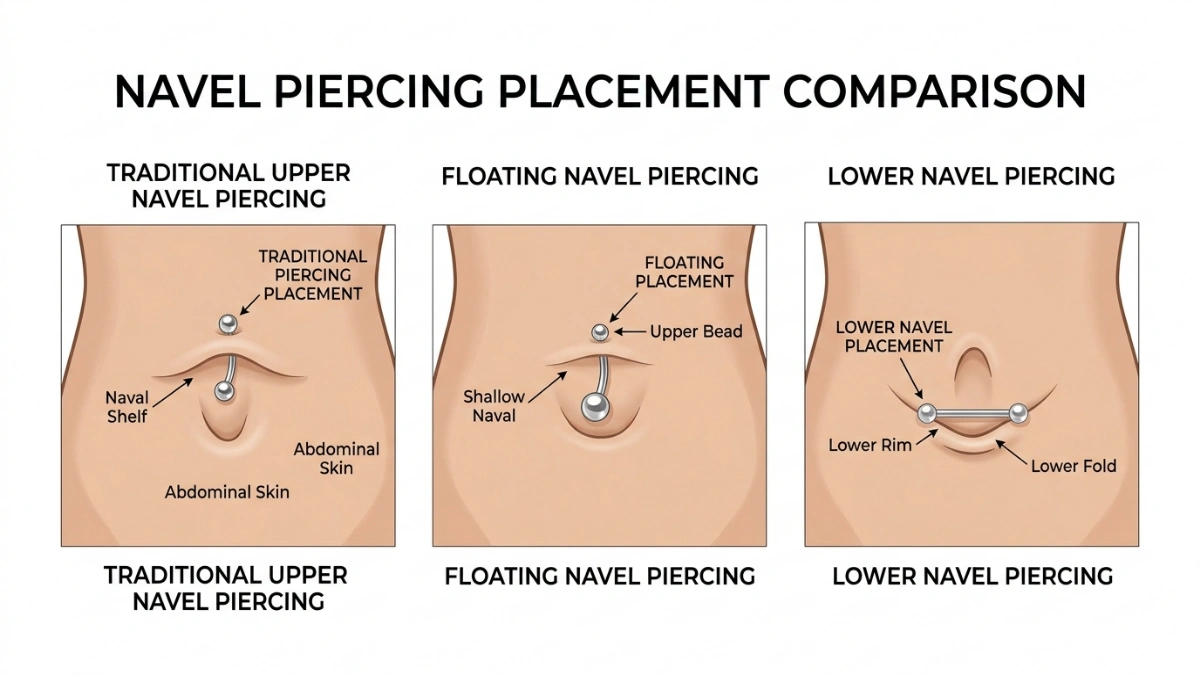
Different navel piercing styles suit different anatomy. A piercing that works well for one person may not be suitable for someone with a shallow navel or a fold that presses against the jewelry.
Traditional Upper Belly Button Piercing
The traditional upper navel piercing passes through the upper rim of skin above the belly button.
It is one of the most recognizable navel piercing styles and commonly uses a curved barbell with decorative ends. For example, you might choose a plain titanium piece for a minimalist appearance or a small gemstone for extra detail.
This style works best when the upper rim has enough suitable tissue to support the jewelry without excessive pressure.
Floating Navel Piercing
A floating navel piercing uses jewelry designed to sit more comfortably when the lower part of the navel compresses during sitting or bending.
Instead of a prominent lower bead, the jewelry often has a flatter bottom end. As a result, it may suit some people whose belly button folds inward when they sit.
However, a floating navel piercing still requires suitable anatomy. A professional piercer should determine whether this style is appropriate for you.
Lower Belly Button Piercing
A lower or inverse navel piercing places the jewelry through the lower rim of the belly button rather than the upper rim.
This placement creates a different look, especially with a decorative gemstone or curved barbell. Nevertheless, not everyone has enough suitable tissue in the lower rim, so an in person anatomy assessment is essential.
Double Belly Button Piercing
A double navel piercing combines two placements, often one above and one below the navel.
The result can look symmetrical and distinctive. However, two piercings create two healing sites and require additional care. Your anatomy must support both placements safely, and a piercer may recommend starting with one instead.
Belly Button Piercing Jewelry

The right jewelry should suit your anatomy, skin sensitivity, and healing stage. Although decorative pieces can look appealing, the initial jewelry should prioritize fit, material quality, and comfort. The Association of Professional Piercers recommends suitable, high quality jewelry made from materials appropriate for fresh piercings.
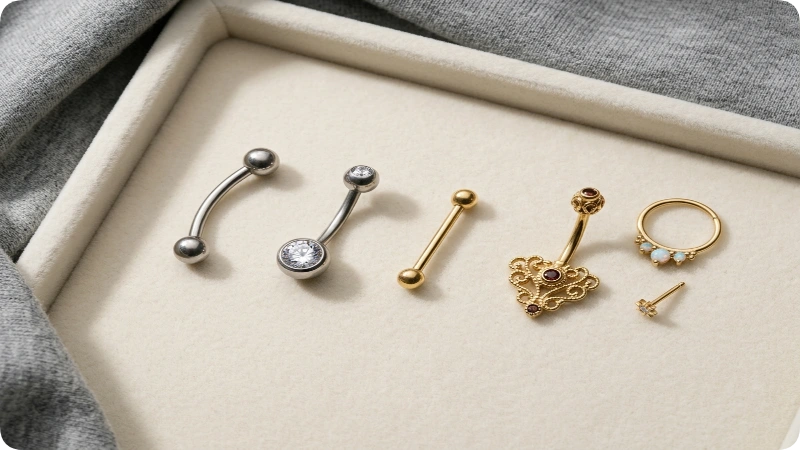
Popular Belly Button Jewelry Styles
| Jewelry Style | Appearance | Best Consideration |
| Curved barbell | Curved bar with decorative ends | Common choice for traditional navel piercings |
| Gemstone barbell | Small crystals or gemstones | Offers a decorative, polished look |
| Floating navel jewelry | Flat lower end with a decorative top | May suit a navel that compresses when sitting |
| Dangle jewelry | Hanging charms or stones | Better reserved for a fully healed piercing |
| Gold tone jewelry | Warm golden appearance | Check the actual metal and coating |
| Minimalist barbell | Simple, understated design | Useful if you prefer a subtle look |
A curved barbell is a common starting point, but the best design depends on your anatomy and placement. In addition, heavy charms and dangling pieces can pull on healing tissue, so wait until the piercing has fully healed before using them.
What Is the Safest Metal for a Belly Button Piercing?
| Material | Suitability | What to Check |
| Implant grade titanium | Strong option for fresh piercings | Confirm the material meets an appropriate implant grade standard |
| Suitable implant grade steel | May be appropriate | Verify its specification, particularly if you have metal sensitivities |
| Solid gold | Can be suitable | Choose biocompatible, nickel and cadmium free gold of at least 14 karats |
| Gold plated jewelry | Avoid for a fresh piercing | The coating can wear away |
| Unknown metal alloys | Avoid | Composition and potential allergens may be unclear |
Material quality matters because new piercing tissue is vulnerable to irritation. Therefore, ask the piercer to identify the jewelry’s material rather than relying on a label such as “hypoallergenic.”
How Much Does a Belly Button Piercing Hurt?
A belly button piercing usually causes a brief, sharp sensation when the needle passes through the tissue. You may then feel pressure, tenderness, or mild throbbing around the area.
However, pain varies from person to person. Your sensitivity, anatomy, stress level, and the piercer’s technique can all influence the experience.
What Happens During the Piercing Procedure?
A professional piercing appointment typically follows these steps:
- Anatomy assessment: The piercer checks your navel and discusses suitable placement.
- Cleaning and marking: They clean the area and mark the proposed entry and exit points.
- Sterile preparation: They prepare the appropriate equipment and jewelry using safe procedures.
- Piercing: They perform the piercing with sterile, single use equipment.
- Jewelry placement: They insert suitable jewelry and explain how to care for the new piercing.
Choose a professional who welcomes questions and explains each step. Avoid attempting to pierce your own navel because incorrect placement and nonsterile equipment can cause serious complications.
Does a Belly Button Piercing Hurt More Than an Ear Piercing?
There is no universal pain ranking. A navel piercing passes through different tissue from an earlobe piercing, and individual experiences vary. The procedure may feel more intense if you are anxious or if the area is particularly sensitive.
Rather than judging the piercing by someone else’s pain score, ask an experienced piercer to explain the process and assess your anatomy.
Belly Button Piercing Healing Time
A navel piercing can take six months to a year or longer to heal fully. Some take longer, especially when clothing repeatedly rubs against the jewelry or the piercing experiences irritation.
Belly Button Piercing Healing Stages
| Stage | What You May Notice | What to Do |
| First few days | Tenderness, mild swelling, or light bleeding | Clean gently and avoid pressure |
| Early healing | Mild itching, crusting, and occasional tenderness | Continue appropriate aftercare |
| Ongoing healing | The outside may look better while internal tissue remains fragile | Keep protecting the piercing |
| Later healing | Less tenderness and discharge | Continue care until fully healed |
| Fully healed | No ongoing tenderness, crusting, or discharge | Ask a professional before changing jewelry if unsure |
These stages are approximate, not a guaranteed schedule. A piercing can look healed on the outside while the internal channel still needs time to recover.
Can You Swim After Getting a Belly Button Piercing?
Avoid submerging a fresh or healing piercing in swimming pools, hot tubs, lakes, oceans, and other bodies of water because they can expose the wound to microorganisms. Follow professional aftercare guidance until the piercing has healed.
If swimming is unavoidable, ask a qualified piercer or healthcare professional about suitable protection. Do not assume that a waterproof covering removes all risks.
Belly Button Piercing Aftercare
Proper aftercare helps reduce irritation and supports healing. The goal is to keep the area clean without repeatedly disturbing the tissue.
How to Clean a Belly Button Piercing
Follow these basic steps, based on the Association of Professional Piercers’ guidance.
- Wash your hands thoroughly before touching the area.
- Spray the piercing with sterile saline wound wash containing 0.9% sodium chloride as the only active ingredient.
- Let the saline loosen any surface debris.
- Gently remove loosened crust without pulling or scraping the tissue.
- Pat the area dry with clean disposable gauze or another suitable disposable product.
Do not twist, spin, or rotate the jewelry while cleaning. Also, avoid overcleaning because repeated friction and harsh products can delay healing.
What Should You Avoid During Healing?
| Avoid | Why It Matters |
| Alcohol and hydrogen peroxide | Can irritate or damage healing tissue |
| Twisting or playing with jewelry | Creates friction and unnecessary trauma |
| Tight waistbands | Can press against or snag the piercing |
| Heavy charms | Add weight and pulling force |
| Lotions and fragranced products | May irritate the piercing |
| Swimming and soaking | Can expose the wound to microorganisms |
| Changing jewelry too early | May injure the healing channel |
Instead, wear clean, comfortable clothing that does not press on your navel. If a jewelry change becomes necessary during healing, ask a qualified piercer to assess and perform it.
Belly Button Piercing Risks and Signs of Infection
Like any piercing, a navel piercing can develop irritation, infection, an allergic reaction, scarring, or migration and rejection. Appropriate placement, suitable jewelry, and consistent aftercare can reduce some risks, but they cannot eliminate them.
What Is Normal After a Belly Button Piercing?
During early healing, you may notice:
- Mild tenderness or localized swelling.
- A small amount of bleeding or bruising.
- Occasional itching.
- Pale fluid that dries into a light crust.
- Mild discoloration around the piercing.
These symptoms should generally improve rather than become increasingly severe. However, healing times vary, and persistent or worsening symptoms deserve professional assessment.
How to Recognize an Infected Belly Button Piercing
Watch for warning signs such as:
- Increasing pain, heat, or swelling.
- Skin that becomes increasingly red or dark.
- Thick yellow, green, or foul smelling discharge.
- Fever, chills, or feeling generally unwell.
- Red streaks extending from the piercing.
If you suspect an infection, seek prompt medical care. Do not remove the jewelry yourself unless a healthcare professional advises you to do so, because removal can sometimes interfere with drainage or complicate an infection.
What Is Piercing Rejection?
Rejection occurs when the body gradually pushes the jewelry toward the skin’s surface. Migration means the jewelry changes position from its original placement.
Signs can include:
- Increasingly visible jewelry beneath thinning skin.
- A piercing hole that appears to move.
- A strip of skin between the entry and exit points that becomes thinner.
- Persistent irritation or a change in the piercing’s angle.
If you notice these changes, consult a qualified piercer promptly. Seek medical advice if the skin is breaking down, the area is painful, or infection is possible.
Belly Button Piercing Cost
The cost of a belly button piercing varies by location, studio, piercer experience, jewelry material, and whether the quoted fee includes aftercare or follow up appointments.
What Affects the Price?
| Cost Factor | Why It Matters |
| Piercing service | Experienced professionals may charge more for their expertise |
| Jewelry material | Implant grade titanium and quality solid gold differ in price |
| Jewelry design | Gemstones and decorative details can increase the cost |
| Studio hygiene | Proper sterilization and professional equipment are essential |
| Follow up care | Some studios include checkups or jewelry downsizing; others charge separately |
Do not choose a studio solely because it offers the lowest price. A safe procedure and correctly fitted jewelry matter more than a bargain.
Because prices vary widely, contact reputable studios in your area for a current quote and ask what the fee includes.
How to Choose a Professional Piercer
A good piercer should assess your anatomy, explain the procedure, use appropriate sterilization practices, and provide clear aftercare instructions.
Before booking, ask these questions:
- Does the studio use sterile, single use needles?
- Does the piercer open sterile equipment in front of clients?
- Do they use an appropriate autoclave for reusable equipment?
- Can they explain the material and quality of the initial jewelry?
- Will they assess whether my navel anatomy suits the piercing?
- Do they provide written aftercare guidance and follow up support?
Also, observe the studio’s cleanliness and whether staff use clean gloves and handle equipment appropriately. The Association of Professional Piercers provides a useful guide for evaluating a piercing studio.
Frequently Asked Questions About Belly Button Piercing
1. How long does a belly button piercing take to heal?
A belly button piercing commonly takes six months to a year or longer to heal fully. Friction, unsuitable jewelry, and repeated irritation can extend the process. Do not assume it has healed just because it looks normal.
2. Can you get a belly button piercing if you have a small belly button?
Possibly. The size of your navel alone does not determine suitability. A professional piercer should assess the available tissue, the shape of the navel, and how the area folds when you sit or bend.
3. Is a belly button piercing painful?
Most people experience a brief sharp sensation followed by tenderness. However, pain varies with individual sensitivity, anatomy, anxiety, and technique.
4. When can you change belly button piercing jewelry?
Wait until the piercing has fully healed before changing jewelry for appearance. Because healing can take a year or longer, ask a qualified piercer to assess readiness. If the jewelry needs adjustment during healing, have a professional handle it.
5. Can you sleep on your stomach with a new belly button piercing?
Pressure and friction from sleeping on your stomach may irritate a new piercing. Try a position that avoids direct pressure on the navel, especially during early healing.
6. Can you exercise with a belly button piercing?
Gentle exercise may be possible, but avoid activities that repeatedly pull, press, or snag the jewelry. Clean equipment and clothing that does not rub against the piercing can help reduce irritation.
7. Can you swim with a new belly button piercing?
It is best to avoid swimming and submerging a healing piercing in pools, hot tubs, lakes, and oceans. These environments can expose the wound to microorganisms, so wait until it has healed.
8. What jewelry is best for a new belly button piercing?
A properly fitted curved barbell made from verified implant grade titanium is a common option. The piercer should select the appropriate size and style for your anatomy rather than choosing jewelry based on appearance alone.
9. Why does my belly button piercing smell?
A healed piercing can accumulate normal skin oils, dead skin cells, and secretions that cause an odor. Gentle routine cleaning may help. However, a strong foul smell accompanied by pain, swelling, heat, or unusual discharge needs medical assessment.
10. Can a belly button piercing leave a scar?
Yes. Even after the jewelry is removed and the hole closes, a small mark or scar may remain. Migration, rejection, infection, and individual healing characteristics can increase the likelihood of noticeable scarring.
Key Takeaways
- A belly button piercing should suit your anatomy, not just your preferred style.
- Traditional upper, floating, lower, and double navel piercings offer different placements.
- Full healing commonly takes six months to a year or longer.
- Choose suitable, high quality jewelry and follow gentle saline aftercare.
- Avoid pressure, harsh cleaning products, premature jewelry changes, and swimming during healing.
- Seek prompt medical care if you notice signs of infection.
Conclusion
A belly button piercing can be a stylish form of self expression, whether you prefer a minimalist curved barbell or a decorative gemstone. However, choosing a reputable piercer, selecting suitable jewelry, and allowing enough time for healing are essential parts of the process.
Before booking an appointment, have a professional assess your navel anatomy and explain the risks, aftercare, and likely costs. With realistic expectations and consistent care, you can make a more informed decision about whether a navel piercing suits you.

Leave a Reply