
Feature Snippet:
Old Irish names offer a fascinating connection to the earliest written traditions of the Irish language. These names appeared in medieval Irish records, mythology, royal histories, religious traditions, and early Irish literature. Some Old Irish names have meanings that remain easy to understand today. Bran, for example, means “raven,” while Cian means “ancient” or “enduring.” Áine means “radiance” or “brilliance,” and Muirgel means “bright sea.”
Other names have uncertain meanings or survive primarily as historical forms. Therefore, it is important to distinguish documented Old Irish names from modern Irish names that developed later.
Whether you are researching Irish ancestry, writing historical fiction, creating a fantasy character, or simply looking for an ancient name with Celtic roots, this guide explores some of the most interesting Old Irish choices.
Table of Contents
| Section | What You’ll Learn |
| What Are Old Irish Names? | The history and meaning of Old Irish |
| Old Irish Boy Names | Ancient masculine names |
| Old Irish Girl Names | Ancient feminine names |
| Old Irish Unisex Names | Names recorded for more than one gender |
| Old Irish Mythology Names | Names connected with Irish legends |
| Old Irish Names With Strong Meanings | Names connected with power, courage, and leadership |
| Old Irish Nature Names | Names inspired by animals, water, fire, and nature |
| Rare Old Irish Names | Less familiar historical choices |
| Old Irish Name Elements | Common linguistic roots |
| How to Choose an Old Irish Name | Practical naming considerations |
| FAQs | Common questions about Old Irish names |
| Key Takeaways | Quick summary |
What Are Old Irish Names?
Old Irish refers to an earlier stage of the Irish language. Behind the Name describes Old Irish as the form of Irish spoken up to approximately the 10th century.
This distinction matters because Old Irish is not exactly the same as modern Irish Gaelic.
For example:
- Áed is an Old Irish form of the later Irish Aodh.
- Aífe is the Old Irish form of Aoife.
- Brigit is the Old Irish form behind the later Brigid/Bridget tradition.
- Cathal survives in Irish today, but its documented history reaches back to Old Irish.
Consequently, an article about Old Irish names should not simply collect modern Irish names and call them ancient.
Old Irish Boy Names
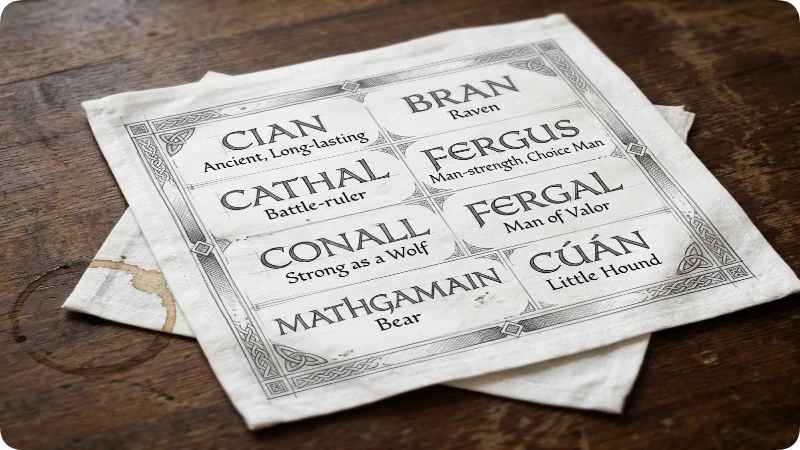
Old Irish masculine names often appear in early royal histories, saints’ lives, Irish mythology, and medieval literature.
| Name | Meaning or Origin | Historical Connection |
| Áed | Old Irish form of Aodh | Irish mythology |
| Áedán | Old Irish form of Aodhán | Early Irish history |
| Ailill | “Elf” | Early Irish kings and mythology |
| Bran | “Raven” | Irish mythology |
| Cathal | “Battle” + “rule” | Saint and kings |
| Cúán | “Little wolf” or “little hound” | Early saint |
| Cormacc | Old Irish form of Cormac | Historical and legendary |
| Cian | “Ancient, enduring” | Irish mythology |
| Fergus | “Man of vigour” | Irish mythology and history |
| Fergal | “Man of valour” | Early Irish king |
| Mathgamain | “Bear” | Early Irish history |
| Muirchertach | “Mariner” | Irish high king |
| Conall | “Rule of a wolf” | Irish mythology |
| Óengus | Old Irish form of Aonghus | Irish mythology |
Cian
Cian means “ancient” or “enduring.” In Irish mythology, Cian was the father of Lugh Lámfada and an ancestor associated with the Ciannachta.
Its concise form makes Cian particularly interesting for someone who wants an ancient name that still feels usable today.
Bran
Bran means “raven” in Irish. The name appears in Irish mythology, most notably in the story of Bran mac Febail, a legendary mariner who journeys toward the Otherworld.
Cathal
Cathal comes from Old Irish elements meaning “battle” and “rule.” It was borne by a 7th century Irish saint and several Irish kings.
Fergus
Fergus means “man of vigour.” Its elements are associated with “man” and “vigour, strength, force.” The name appears in Irish history and mythology, including the legendary Fergus mac Róich.
Fergal
Fergal means “man of valour.” It comes from Old Irish elements meaning “man” and “valour.” The name was borne by an 8th century king of Ireland.
Old Irish Girl Names

Old Irish feminine names can be especially distinctive because many have disappeared from everyday modern naming.
| Name | Meaning or Association | Background |
| Áednat | Feminine diminutive of Áed | Old Irish |
| Aíbinn | Old Irish form of Aoibheann | Old Irish |
| Aífe | Old Irish form of Aoife | Mythology |
| Áine | “Radiance, brilliance” | Mythology |
| Bébinn | “White woman” | Mythology |
| Brigit | Old Irish form of Bridget | Mythology |
| Muirenn | “Sea” + “white/blessed” | Mythology |
| Muirgel | “Bright sea” | Old Irish |
| Gormlaith | “Blue/illustrious” + “ruler” | Medieval royalty |
| Gráinne | Possibly related to “grain” or “hatred/fear” | Mythology |
| Órlaith | “Golden ruler” | Medieval royalty |
| Síthmaith | “Good peace” | Old Irish |
| Sláine | “Health, safety” | Mythology |
| Étaín | Possibly related to “jealousy, passion” | Mythology |
These meanings come from documented Old Irish entries, although some etymologies remain uncertain.
Áine
Áine means “radiance” or “brilliance.” In Irish mythology, Áine was a goddess associated with love and fertility. She was traditionally connected with Cnoc Áine in County Limerick.
Bébinn
Bébinn means “white woman,” combining Old Irish bé, “woman,” with finn, meaning “white” or “blessed.” Several figures in Irish mythology bear the name.
Muirgel
Muirgel means “bright sea.” It combines Old Irish muir, “sea,” with gel, “bright.”
Gormlaith
Gormlaith combines Old Irish gorm, associated with “blue” or “illustrious,” and flaith, meaning “ruler, sovereign, princess.” Several medieval Irish royal women bore the name.
Órlaith
Órlaith means “golden ruler.” It combines Old Irish ór, “gold,” with flaith, “ruler, sovereign, princess.” The name was borne by several medieval Irish royals.
Old Irish Unisex Names
| Name | Meaning | Notes |
| Ailbe | Possibly “world, light, white” or related to “rock” | Male and female |
| Ciar | “Black” | Male and female |
| Flann | “Blood red” | Male and female |
| Sláine | “Health, safety” | Male and female |
| Ailbhe | Modern form of Ailbe | Male and female usage |
| Ciar | Old Irish and Irish | Mythological and historical |
Ailbe is particularly interesting because its etymology is uncertain. It may connect with a Celtic root meaning “world, light, white” or with Old Irish ail, “rock.” In Irish legend, Ailbe was the name of a female warrior, while Saint Ailbe was a male religious figure.
Ciar derives from Irish ciar, meaning “black,” and was used for both male and female figures.
Flann means “blood red” and was used for both genders. It was borne by a 9th century high king of Ireland.
Old Irish Mythology Names

Irish mythology preserves many ancient names that remain recognizable today.
| Name | Mythological Connection | Meaning / Background |
| Áine | Goddess associated with love and fertility | Radiance, brilliance |
| Aífe | Legendary female figures | Old Irish form of Aoife |
| Bébinn | Several mythological figures | White woman |
| Bran | Bran mac Febail | Raven |
| Cian | Father of Lugh | Ancient, enduring |
| Étaín | Central figure in an early tale | Possibly passion/jealousy |
| Gráinne | The Pursuit of Diarmaid and Gráinne | Etymology uncertain |
| Muirenn | Mother of Fionn in one tradition | Sea + white/blessed |
| Sláine | Legendary high king | Health, safety |
| Óengus | Irish mythology | Old Irish form of Aonghus |
The mythology surrounding these names varies across texts and traditions, so it is better to describe the individual legends rather than reduce each name to a single modern interpretation.
Old Irish Names Meaning Strength and Courage
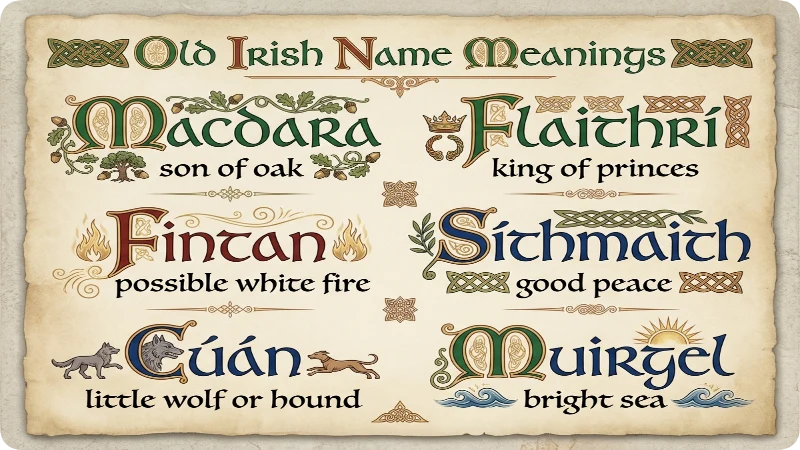
Some Old Irish names have meanings directly connected with strength, battle, valour, or power.
Fergus
Fergus means “man of vigour”, with guss carrying the sense of vigour, strength, or force.
Fergal
Fergal means “man of valour.” This gives the name a direct connection with courage.
Cathal
Cathal contains the Old Irish element cath, meaning “battle,” alongside an element associated with rule.
Brian
Brian has an uncertain etymology. One proposed explanation connects it with an ancient Celtic root associated with “hill, high,” while another links it with brigā, “might, power.” Because the etymology is disputed, it is better not to state “strong” as its definitive meaning.
| Name | Strength Related Idea |
| Fergus | Vigour, strength, force |
| Fergal | Valour |
| Cathal | Battle and rule |
| Brian | Possible connection with might/power |
| Conall | Rule of a wolf |
Old Irish Nature Names
Nature appears frequently in Old Irish names and mythology.
| Name | Meaning | Nature Theme |
| Bran | Raven | Bird |
| Cúán | Little wolf or little hound | Animal |
| Mathgamain | Bear | Animal |
| Muirgel | Bright sea | Water |
| Muirenn | Sea + white/blessed | Water |
| Bláán | Yellow | Color |
| Donndubán | Brown + dark | Color |
| Macdara | Son of oak | Tree |
| Fintan | Possibly “white fire” | Fire |
| Ailbe | Possibly world/light/white or rock | Nature/elemental |
Macdara means “son of oak” and was the name of a 6th century saint from Connemara.
Cúán means “little wolf” or “little hound,” formed from Old Irish cú with a diminutive suffix.
Mathgamain means “bear” and was borne by a brother of the Irish king Brian Boru.
Old Irish Names Connected With Royalty
Old Irish naming traditions include several names associated with kings, queens, rulers, and aristocratic families.
Gormlaith
Gormlaith combines ideas of blue or illustrious and rulership. Several medieval Irish royal women bore the name.
Órlaith
Órlaith means “golden ruler” and was used by several medieval Irish royal women.
Ailill
Ailill means “elf” and was borne by several early Irish kings. It also appears frequently in Irish legend.
Conall
Conall means “rule of a wolf.” The name appears in Irish mythology and historical tradition.
Flaithrí
Flaithrí means “king of princes.” It combines flaith, “ruler, sovereign, prince,” with rí, “king.”
Rare Old Irish Names
If you want something particularly distinctive, several documented Old Irish names are much less familiar to modern English speakers.
| Name | Gender | Meaning / Background |
| Affraic | Girl | Old Irish form of Aifric |
| Aíbinn | Girl | Old Irish form of Aoibheann |
| Áednat | Girl | Feminine diminutive of Áed |
| Muirgel | Girl | Bright sea |
| Síthmaith | Girl | Good peace |
| Órlaith | Girl | Golden ruler |
| Berach | Boy | Sharp, pointed |
| Caíndelbán | Boy | Handsome + form/image |
| Cathassach | Boy | Vigilant |
| Conrí | Boy | King of hounds |
| Dálach | Boy | Assembly/meeting |
| Flaithrí | Boy | King of princes |
| Iarlaithe | Boy | Unknown element + ruler |
| Mathgamain | Boy | Bear |
Several of these are genuinely historical forms rather than modern inventions.
Old Irish Names With Beautiful Meanings
If you are primarily choosing a name for its meaning, these are particularly interesting.
| Name | Meaning |
| Áine | Radiance, brilliance |
| Cian | Ancient, enduring |
| Bran | Raven |
| Cúán | Little wolf or little hound |
| Fergus | Man of vigour |
| Fergal | Man of valour |
| Muirgel | Bright sea |
| Órlaith | Golden ruler |
| Bébinn | White woman |
| Síthmaith | Good peace |
| Sláine | Health, safety |
| Gormlaith | Blue/illustrious + ruler |
Meanings with uncertain etymologies should be treated as possibilities rather than absolute translations. For example, Gormlaith and Ailbe have documented but nuanced etymological histories.
Old Irish Names From Early Saints
Christianity had a major influence on medieval Irish culture, and many Old Irish names are connected with early saints.
| Name | Historical Connection |
| Abbán | 6th century Irish saint |
| Cathal | 7th century Irish saint |
| Cathán | 6th century Irish monk |
| Cianán | 5th century Irish saint |
| Berach | 6th century Irish saint |
| Bláán | 6th century bishop |
| Senán | 6th century monk |
| Máedóc | 7th century Irish bishop |
| Ailbe | 6th century male saint |
| Brigit | Old Irish form of Bridget |
For example, Abbán means “little abbot” and was the name of a 6th century Irish saint. Senán means “little old one” and belonged to a 6th century monk associated with a monastery on Inis Cathaigh.
Old Irish Name Elements
Understanding individual Old Irish elements can help explain why many ancient names have compound meanings.
Muir
Muir means “sea.” It appears in names such as Muirgel and Muirenn.
Finn
Finn can carry meanings such as “white” or “blessed.” It appears in names including Bébinn and Muirenn.
Flaith
Flaith is associated with “ruler, sovereign, prince.” It appears in names such as Gormlaith, Órlaith, and Flaithrí.
Rí
Rí means “king.” It appears in the Old Irish name Flaithrí.
Cath
Cath means “battle.” It appears in Cathal and Cathán.
Cú
Cú can mean “wolf” or “hound.” It appears in Cúán and in the etymology of Conall.
Old Irish Names vs Modern Irish Names
It is easy to confuse these two categories.
Old Irish names refer to names documented in the older stage of the Irish language. Modern Irish names may descend from those names but have different spellings, sounds, or grammatical forms.
| Old Irish | Later or Modern Form |
| Áed | Aodh |
| Áedán | Aodhán |
| Aífe | Aoife |
| Ailbe | Ailbhe |
| Brigit | Bridget / Brigid |
| Óengus | Aonghus |
| Oissíne | Oisín |
| Muirchertach | Muircheartach |
| Cormacc | Cormac |
| Domnall | Domhnall |
Behind the Name explicitly identifies several of these as Old Irish forms of later Irish names.
This distinction is useful if historical authenticity matters to you.
How to Choose an Old Irish Name
Decide Whether You Want Historical Accuracy
If you are naming a fictional character, researching genealogy, or choosing a baby name, your requirements may differ.
A historically accurate Old Irish name may have spelling and pronunciation that feel unfamiliar today. A modern Irish form may be easier to use while still preserving the older name’s heritage.
Consider Pronunciation
Old Irish spelling does not always correspond to modern English pronunciation.
If you choose a historically spelled name such as Áed, Óengus, or Muirchertach, check its pronunciation carefully rather than assuming an English reading.
Look at the Meaning
Some names have straightforward meanings, such as:
- Bran — raven
- Cian — ancient, enduring
- Áine — radiance, brilliance
- Muirgel — bright sea
- Órlaith — golden ruler
Others have uncertain etymologies. In those cases, a name should not be marketed as having one definitive meaning when the historical evidence is more complicated.
Consider the Modern Form
If you love an Old Irish name but want something easier for everyday use, investigate its later Irish form.
For example, Aífe became Aoife, while Óengus corresponds to Aonghus.
Frequently Asked Questions
What are Old Irish names?
Old Irish names are names documented in the Old Irish language, the form of Irish spoken up to approximately the 10th century.
What is the oldest Irish name?
There is no single universally accepted “oldest Irish name.” The historical record contains personal names from different periods and sources, while some names have uncertain dates or earlier Celtic roots.
What Old Irish name means ancient?
Cian means “ancient, enduring” in Irish and has documented connections with Old Irish and Irish mythology.
What Old Irish name means raven?
Bran means “raven” in Irish and is documented as an Old Irish name associated with Irish mythology.
What Old Irish girl name means radiance?
Áine means “radiance, brilliance.” It is also the name of a goddess in Irish mythology associated with love and fertility.
What Old Irish name means bright sea?
Muirgel means “bright sea,” combining Old Irish muir, “sea,” and gel, “bright.”
What Old Irish name means golden ruler?
Órlaith means “golden ruler,” combining ór, “gold,” and flaith, “ruler, sovereign, princess.”
Are Aoife and Aífe the same name?
They are closely connected. Aífe is documented as the Old Irish form of Aoife.
Is Brigid an Old Irish name?
The Old Irish form is Brigit. Modern Irish and English forms developed from this older form.
Are Old Irish names still used today?
Some Old Irish names survive through modern Irish forms. Others remain mainly historical or literary. Names such as Cian, Áine, Aoife, Ailbhe, and Oisín demonstrate how older naming traditions continue into modern Irish usage.
Key Takeaways
- Old Irish refers to an earlier stage of the Irish language spoken up to approximately the 10th century.
- Old Irish names appear in mythology, royal histories, saints’ lives, and medieval Irish literature.
- Cian means “ancient, enduring.”
- Bran means “raven.”
- Áine means “radiance, brilliance.”
- Muirgel means “bright sea.”
- Órlaith means “golden ruler.”
- Fergus means “man of vigour.”
- Fergal means “man of valour.”
- Cathal combines the ideas of battle and rule.
- Gormlaith has a meaning connected with rulership.
- Aífe is the Old Irish form of Aoife.
- Brigit is the Old Irish form behind Bridget.
- Some Old Irish etymologies remain uncertain, so historical meanings should not always be treated as absolute.
- Modern Irish names can descend from Old Irish forms but should not automatically be classified as Old Irish themselves.
Conclusion
Old Irish names provide a window into the language, mythology, history, and culture of medieval Ireland. Their meanings range from raven, wolf, sea, and fire to radiance, courage, peace, rulership, and strength. For girls, names such as Áine, Bébinn, Muirgel, Gormlaith, Órlaith, and Síthmaith offer distinctive historical choices. For boys, Cian, Bran, Cathal, Fergus, Fergal, Conall, and Mathgamain connect strongly with Old Irish history and mythology. If authenticity matters, pay attention to the difference between an Old Irish form and its later Irish descendant. That small distinction can make a significant difference when you are looking for a genuinely ancient Irish name rather than simply a modern Irish name.

Leave a Reply