Feature Snippet:
Spanish names offer a wonderful mix of history, musical sounds, meaningful words, and regional traditions. If you want a name that feels distinctive without sounding invented, rare Spanish names are an excellent place to start. Some choices come from medieval Spanish history, while others reflect Latin roots, religious traditions, nature, or older regional languages such as Basque and Galician. Moreover, a name can feel uncommon in the United States while remaining familiar in Spain or Latin America. Therefore, rarity depends on the country, generation, and naming community.
This guide explores uncommon Spanish names for girls and boys, along with their meanings, linguistic backgrounds, pronunciation notes, and distinctive qualities. It also separates names that originated in Spanish from names that Spanish speakers adopted from other languages.
Table of Contents
| Section | What You’ll Learn |
| Rare Spanish Girl Names | Distinctive feminine names and their backgrounds |
| Rare Spanish Boy Names | Traditional and uncommon masculine choices |
| Rare Spanish Names With Beautiful Meanings | Names connected with nature, virtues, and positive qualities |
| Rare Traditional and Regional Names | Historic names and regional linguistic traditions |
| Short and Elegant Spanish Names | Compact names with distinctive styles |
| How to Choose a Rare Spanish Name | Practical tips for choosing a suitable name |
| Frequently Asked Questions | Answers to common questions about uncommon Spanish names |
Rare Spanish Girl Names

These feminine names include traditional Spanish choices, older forms, and names that may be less familiar to English speaking readers. However, their actual rarity varies by country and generation.
Distinctive Spanish Girl Names With Traditional Roots
| Name | Meaning or Background | Origin |
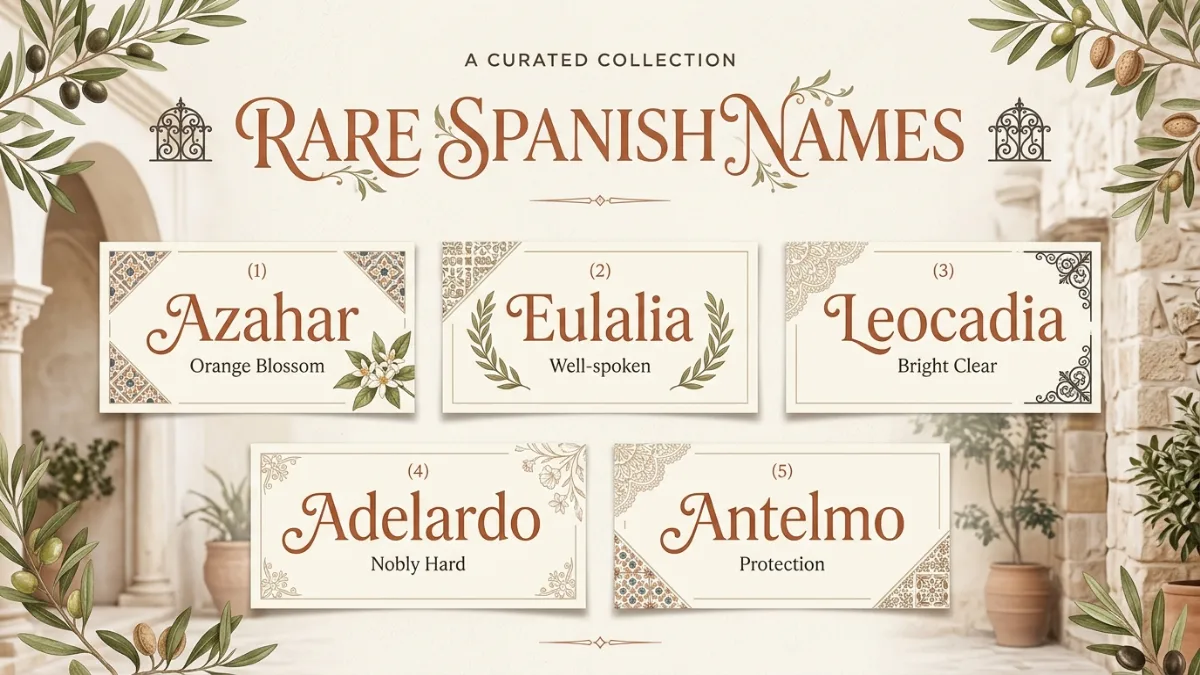
| Eulalia | Associated with “well spoken” | Greek; used in Spanish |
| Leocadia | Traditionally associated with the name of Saint Leocadia | Greek derived name used in Spanish |
| Casilda | Origin uncertain; a traditional Spanish feminine name | Spanish usage; debated etymology |
| Jacinta | Hyacinth, the flowering plant | Greek, through Spanish |
| Remedios | Remedies; associated with the Virgin Mary title Nuestra Señora de los Remedios | Spanish |
| Socorro | Help or assistance; also a religious title | Spanish |
| Fuencisla | Associated with the Virgin of La Fuencisla in Segovia | Spanish religious tradition |
| Nieves | Snows; associated with Nuestra Señora de las Nieves | Spanish |
| Visitación | Visitation; associated with the biblical Visitation | Latin through Spanish religious usage |
These names offer different styles. For example, Eulalia and Leocadia have an antique, literary quality, whereas Nieves and Socorro reflect established Spanish religious and cultural traditions.
Uncommon Spanish Girl Names With Elegant Sounds
| Name | Meaning or Background | Origin |
| Amparo | Protection or shelter | Spanish |
| Milagros | Miracles; also a religious name | Spanish |
| Soledad | Solitude; associated with the Virgin Mary title Nuestra Señora de la Soledad | Spanish |
| Consuelo | Consolation or comfort | Spanish |
| Araceli | Traditionally interpreted as “altar of heaven” | Latin derived Spanish name |
| Maravillas | Wonders; associated with Spanish Marian devotion | Spanish |
| Rocío | Dew | Spanish |
| Estrella | Star | Spanish |
| Belén | Bethlehem; also a Spanish feminine given name | Hebrew place name through Spanish |
A useful distinction: Some names have straightforward word meanings, such as Rocío and Estrella. Others, including Amparo and Consuelo, express abstract ideas. Religious associations add another layer of significance, but they do not replace a name’s literal meaning.

Rare Spanish Boy Names
Rare Spanish boy names range from medieval forms to names rooted in Latin, Germanic languages, and Christian history. Some have a distinctly traditional sound, while others feel short and modern.
Uncommon Spanish Boy Names With Historic Roots
| Name | Meaning or Background | Origin |
| Adelardo | Spanish form of Adalhard, associated with nobility and strength | Germanic through French |
| Abelardo | Spanish form of Abélard | French derived |
| Antelmo | Spanish form of Anthelm | Germanic through Italian and related forms |
| Avelino | Used in honor of Saint Andrea Avellino | Italian place name origin, adopted in Spanish |
| Custodio | Guardian or keeper | Spanish, from Latin |
| Telmo | Historically connected with the name Santelmo | Spanish |
| Solano | Associated with Spanish place names meaning a sunny place | Spanish surname and given name tradition |
| Albano | Spanish form of Albanus | Latin |
| Calisto | Spanish form of Callistus | Greek through Latin |
| Tercero | Third; historically used for a third born child | Spanish |
These names suit different preferences. For instance, Adelardo has an old world character, while Telmo offers a shorter, simpler option. Meanwhile, Custodio has a direct meaning that appeals to readers who prefer names with a clear connection to a personal quality.
Distinctive Spanish Boy Names With Meaningful Associations
| Name | Meaning or Association | Style |
| Amor | Love | Romantic, word based |
| Cruz | Cross | Short, religious |
| Santos | Saints | Traditional, religious |
| Avelino | Honor of Saint Andrea Avellino | Historical |
| Solano | Sunny place association | Nature inspired |
| Albano | Related to the Latin name Albanus | Classic |
| Adelardo | Noble and strong elements in its Germanic root | Historic |
| Custodio | Guardian or keeper | Meaningful, traditional |
Keep the distinction between language and origin in mind. A name used in Spanish does not always originate in Spanish. For example, Adelardo has Germanic roots, while Cruz is directly connected to the Spanish word for “cross.”
Rare Spanish Names With Beautiful Meanings
If meaning matters more to you than a particular sound, start with names whose linguistic roots or Spanish word forms have clear interpretations. The following options connect with nature, love, protection, and other meaningful ideas.
Spanish Names Connected With Nature
| Name | Meaning | Gender or Usage |
| Azahar | Orange blossom | Feminine |
| Alondra | Lark, a songbird | Feminine |
| Rocío | Dew | Feminine |
| Estrella | Star | Feminine |
| Sol | Sun | Feminine and masculine usage |
| Orquídea | Orchid | Feminine |
| Flor | Flower | Feminine |
| Ámbar | Amber | Primarily feminine in contemporary Spanish naming |
These choices offer different kinds of natural imagery. Azahar stands out for its connection to orange blossoms, whereas Rocío evokes morning dew. Similarly, Sol is a compact choice with a direct meaning.
Spanish Names Associated With Love, Faith, and Protection
| Name | Meaning or Association | Origin or Context |
| Amor | Love | Spanish vocabulary word; Latin roots |
| Amparo | Protection, shelter, refuge | Spanish religious tradition |
| Consuelo | Consolation, comfort | Spanish |
| Fe | Faith | Spanish, from Latin |
| Milagros | Miracles | Spanish religious tradition |
| Socorro | Help, relief, assistance | Spanish religious tradition |
| Adoración | Adoration | Spanish Christian tradition |
| Auxiliadora | Helper | Spanish and Portuguese religious tradition |
For a name that expresses affection directly, Amor is an option. However, Consuelo and Amparo communicate comfort and protection rather than romantic love. Meanwhile, Fe offers a short name with a straightforward meaning.
Rare Traditional and Regional Spanish Names

Spanish naming traditions extend beyond names derived from Castilian Spanish. Spain also has regional languages, including Basque, Catalan, and Galician, whose naming traditions deserve separate attention.
Traditional Spanish Names With Cultural History
These names have identifiable historical or cultural associations; this does not mean that every name is rare in every Spanish speaking country.
| Name | Background | Why It Stands Out |
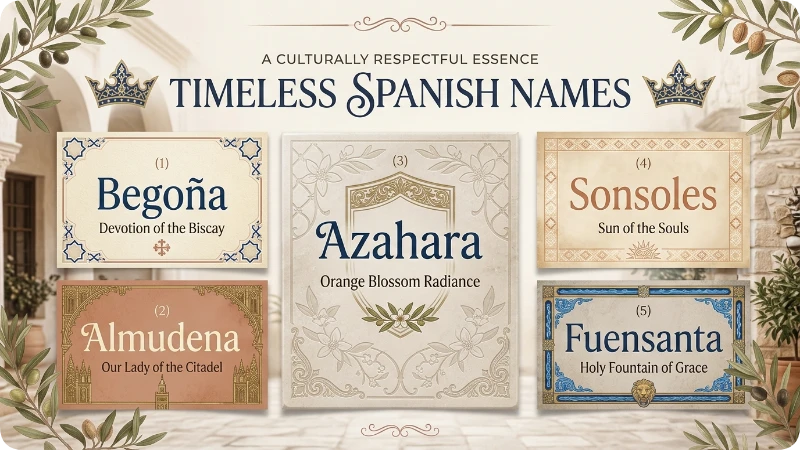
| Almudena | Derived from Arabic al mudayna, “the citadel” | Closely associated with Madrid |
| Begoña | Connected with the Marian title Nuestra Señora de Begoña | Strong Basque regional association |
| Fuensanta | “Holy fountain” or “holy spring” | Spanish religious tradition |
| Azahara | Variant related to Azahar; also associated with Medina Azahara | Andalusian cultural and historical associations |
| Sonsoles | Connected with the title Nuestra Señora de Sonsoles | Regional religious tradition in Ávila |
| Adoración | Refers to adoration in Christian tradition | Distinctive devotional name |
| Nieves | “Snows”; connected with Our Lady of the Snows | Traditional Spanish religious name |
| Soledad | “Solitude”; associated with a Marian title | Traditional and symbolic |
These names carry more context than a simple list of meanings can show. For example, Almudena connects with Madrid’s history, while Begoña reflects a Basque religious and regional tradition.
Spanish Names With Arabic, Latin, and Greek Connections
| Name | Linguistic Background | Meaning or Connection |
| Almudena | Arabic through Spanish | “The citadel” |
| Azahar | Arabic root through Spanish | Orange blossom |
| Jacinta | Greek through Spanish | Hyacinth |
| Eulalia | Greek through Spanish | “Well spoken” |
| Araceli | Latin derived Spanish name | Traditionally interpreted as “altar of heaven” |
| Leocadia | Greek derived name used in Spanish | Historical name associated with Saint Leocadia |
| Belén | Hebrew place name through Spanish | Bethlehem |
| Amaranta | Spanish form of Amarantha | Related to the amaranth name tradition |
Spanish names reflect centuries of language contact, migration, religion, and cultural exchange. Therefore, a name can belong to Spanish naming tradition without having a purely Spanish etymology.
Short and Elegant Rare Spanish Names
Short names can feel distinctive without being difficult to spell. If you want something easy to say in both Spanish and English, these options are worth considering.
| Name | Meaning | Style |
| Sol | Sun | Minimalist, nature inspired |
| Fe | Faith | Simple, traditional |
| Cruz | Cross | Strong, symbolic |
| Flor | Flower | Gentle, nature inspired |
| Amor | Love | Romantic, expressive |
| Rocío | Dew | Elegant, distinctly Spanish |
| Belén | Bethlehem | Traditional, familiar in Spanish |
| Telmo | Historic personal name | Short, masculine |
| Alba | Dawn | Bright, elegant |
| Luz | Light | Simple, meaningful |
Not every name in this table is rare throughout the Spanish speaking world. Instead, consider them a shortlist of relatively distinctive options for readers in particular regions or communities.
How to Choose a Rare Spanish Name
A name may look beautiful on a list but feel different when you use it every day. Before making your final choice, consider these practical factors.
1. Decide What Rare Means to You
Do you want a name that is uncommon in the United States, unusual in Spain, or simply less familiar among your family and friends? These are different goals.
For example, Spain’s National Statistics Institute publishes data on names among residents and newborns. Its records distinguish established names from current baby name choices, making it a useful starting point for checking a name’s frequency in Spain.
You can consult the official
Spanish name frequency database
to investigate a particular name.
2. Check the Original Meaning
A name’s meaning can change depending on its linguistic history. Therefore, check whether the meaning comes from a Spanish vocabulary word, an older language, a religious association, or a debated etymology.
For example, Estrella directly means “star” in Spanish. By contrast, Almudena comes from Arabic and has a historical connection with Madrid.
3. Consider Pronunciation and Spelling
If your family speaks both Spanish and English, try saying the name aloud in both languages. Pay attention to:
- Whether people can pronounce it comfortably.
- Whether accent marks matter for the intended spelling.
- Whether others might confuse it with a similar name.
- Whether the name works naturally with your surname.
For example, Rocío contains an accent mark, while Ámbar also preserves a written accent. Keeping the correct spelling respects the name’s Spanish form.
4. Understand the Cultural Context
Some names reflect religious devotion, regional identity, or historical traditions. If you want a name connected with a particular place or heritage, investigate that association rather than relying on a generic baby name definition.
Similarly, distinguish a Spanish language name from one that originated in Spain. Spanish speaking communities throughout Latin America have their own naming practices and influences.
5. Choose a Name That Fits Your Preferred Style
Consider which qualities matter most to you:
- Historic: Adelardo, Leocadia, Eulalia.
- Nature inspired: Azahar, Rocío, Estrella.
- Short and simple: Sol, Fe, Cruz.
- Meaningful: Amor, Amparo, Consuelo.
- Regional or cultural: Begoña, Almudena, Sonsoles.
Ultimately, the right name depends on the sound, meaning, cultural context, and level of familiarity you prefer.
Frequently Asked Questions About Rare Spanish Names
1. What are some rare Spanish names?
Some distinctive options include Azahar, Eulalia, Leocadia, Sonsoles, Adelardo, Antelmo, and Custodio. However, their rarity depends on the country, region, and generation.
2. What is a rare Spanish girl name with a beautiful meaning?
Azahar is an appealing option because it means “orange blossom” in Spanish. Other meaningful choices include Estrella, meaning “star,” and Rocío, meaning “dew.”
3. What are some rare Spanish boy names?
Consider Adelardo, Antelmo, Custodio, Telmo, and Solano. These names have different linguistic histories, so check their origins as well as their meanings before choosing one.
4. What Spanish name means love?
Amor means “love” in Spanish. It also has Latin roots and can be used as a given name. Spanish and Portuguese usage includes both feminine and masculine associations, although individual naming practices vary.
Behind the Name
5. What Spanish names mean light or brightness?
Luz directly means “light” in Spanish. It is a meaningful choice for someone who wants a name with a clear connection to light rather than a more indirect association with brightness.
6. Are rare Spanish names always Spanish in origin?
No. Some names used in Spanish come from Latin, Greek, Arabic, Germanic languages, or other traditions. Adelardo, for example, has Germanic roots, while Almudena derives from Arabic.
7. What are some short and uncommon Spanish names?
Sol, Fe, Cruz, Flor, and Luz are concise choices. Their familiarity varies by community, so short does not automatically mean rare.
8. What are some old fashioned Spanish names that feel distinctive today?
Eulalia, Leocadia, Casilda, Adelardo, and Antelmo have historical or traditional associations. Whether they feel old fashioned or unusual depends on the local naming culture.
9. How can I check whether a Spanish name is genuinely rare?
Check official statistics for your target country. Spain’s National Statistics Institute provides name frequency information, including data for residents and newborns. Remember that a name’s frequency in Spain may differ considerably from its frequency in Mexico, the United States, or another country.
10. Can I use a rare Spanish name if I do not live in Spain?
Yes. You can choose a name from Spanish naming traditions regardless of where you live. However, it is thoughtful to understand its pronunciation, history, cultural associations, and original meaning before making your decision.
Key Takeaways
- Rare Spanish names include historic, regional, nature inspired, and religious choices.
- Azahar, Rocío, and Estrella are distinctive feminine options with nature related meanings.
- Adelardo, Antelmo, and Telmo offer masculine alternatives with historical associations.
- Amor, Luz, and Sol have clear connections to Spanish vocabulary.
- A name’s origin and its use in Spanish are not always the same.
- Check official statistics when rarity matters, and consider pronunciation, spelling, and cultural context before deciding.
Conclusion
Rare Spanish names offer much more than unusual sounds. They can reflect nature, history, religious traditions, regional identity, and centuries of linguistic influence.
If you prefer nature inspired names, explore Azahar, Rocío, or Estrella. For a historic feminine name, consider Eulalia or Leocadia. Meanwhile, Adelardo and Telmo provide distinctive masculine alternatives, and Amor, Luz, and Sol offer short names with clear meanings.
Before settling on a favorite, verify its etymology and check how familiar it is in your intended country or community. That way, you can choose a name that feels distinctive while respecting its genuine linguistic and cultural background.

Leave a Reply