Feature Snippet:
Japanese names offer a remarkable range of sounds, meanings, and visual styles. Some evoke cherry blossoms, moonlight, and the changing seasons, while others reflect courage, wisdom, nature, or hope. If you are searching for unique Japanese names, you can explore traditional choices, modern sounding options, and distinctive names with meaningful kanji.
One important detail makes Japanese naming especially interesting: a name’s meaning often depends on the kanji used to write it. The same pronunciation can represent different meanings, while the same kanji may have several possible readings. Therefore, the meanings below describe specific written forms or established associations rather than claiming that every spelling has one fixed definition.
This guide covers Japanese girl names, boy names, gender flexible choices, nature inspired ideas, and less familiar options. It also explains how to choose a name that feels distinctive while respecting Japanese language and culture.
Table of Contents
| Section | What You’ll Learn |
| Unique Japanese Girl Names | Feminine names with beautiful meanings |
| Unique Japanese Boy Names | Masculine names associated with strength and character |
| Gender Neutral Japanese Names | Names used across genders or with flexible usage |
| Japanese Names Inspired by Nature | Names connected with flowers, seasons, and the natural world |
| Japanese Names Inspired by Light and the Sky | Names associated with sunshine, stars, and the moon |
| Rare Sounding and Distinctive Japanese Names | Less familiar options and historical choices |
| Japanese Names With Beautiful Kanji | How written characters shape a name’s meaning |
| How to Choose a Unique Japanese Name | Practical tips for spelling, meaning, and cultural fit |
Unique Japanese Girl Names
Japanese girl names often draw inspiration from flowers, seasons, beauty, and positive qualities. However, the written characters matter just as much as the sound. The following examples show specific kanji combinations and their meanings.
Elegant Japanese Girl Names With Beautiful Meanings
| Name | Example Kanji | Meaning of the Kanji |
| Aiko | 愛子 | Love + child |
| Akari | 明里 | Brightness + village or place |
| Hikari | 光 | Light |
| Kaede | 楓 | Maple |
| Koharu | 小春 | Little + spring |
| Misaki | 美咲 | Beauty + blossom |
| Nanami | 七海 | Seven + sea |
| Nozomi | 希 | Hope or wish |
| Shiori | 栞 | Bookmark or guide |
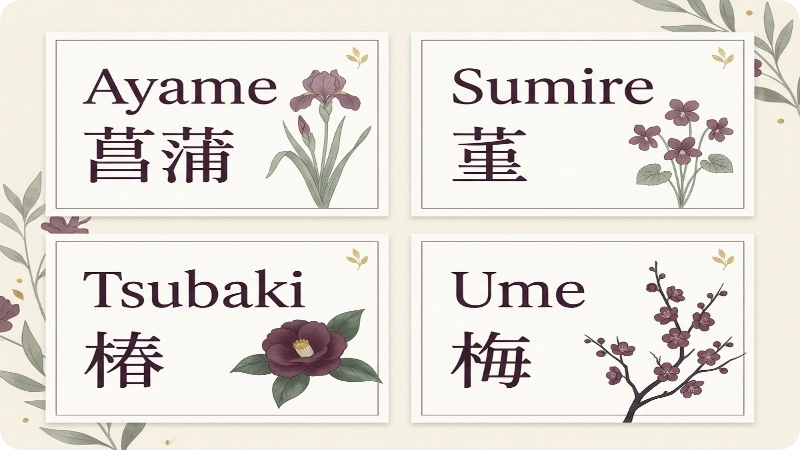
| Sumire | 菫 | Violet flower |
These names offer different styles. For example, Hikari has a simple, luminous meaning, while Kaede appeals to readers who prefer a nature based name. Meanwhile, Shiori has a literary association through its kanji, which means “bookmark.”
Remember that alternative kanji can change the interpretation of several names in this table.
Distinctive Japanese Girl Names With Nature Associations
| Name | Example Kanji | Meaning or Association |
| Ayame | 菖蒲 | Iris |
| Botan | 牡丹 | Peony |
| Himawari | 向日葵 | Sunflower |
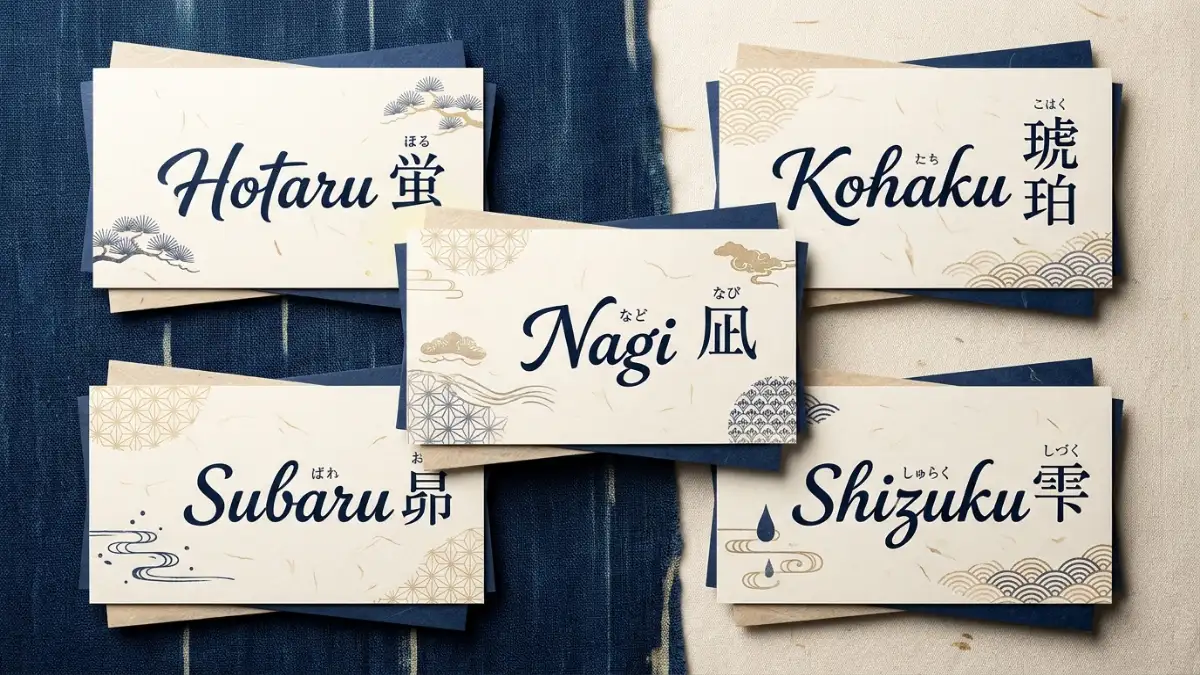
| Hotaru | 蛍 | Firefly |
| Kaori | 香 | Fragrance |
| Sakura | 桜 | Cherry blossom |
| Tsubaki | 椿 | Camellia |
| Ume | 梅 | Japanese plum |
| Wakana | 若菜 | Young greens |
| Yuzuki | 柚希 | Citron + hope |
Nature inspired names can feel distinctive without relying on invented meanings. For example, Hotaru means “firefly” when written as 蛍, while Tsubaki refers to the camellia. In contrast, Yuzuki has a meaning determined by its chosen kanji, so the example above should not be treated as its only possible interpretation.
Unique Japanese Boy Names
Japanese boy names can express courage, wisdom, nature, or aspirations for the future. Some have a traditional feel, while others sound contemporary depending on their kanji and how families use them.
Strong and Meaningful Japanese Boy Names
| Name | Example Kanji | Meaning of the Kanji |
| Akira | 明 | Bright or clear |
| Daichi | 大地 | Great earth |
| Haruki | 春樹 | Spring + tree |
| Hiroshi | 浩 | Broad or abundant |
| Isamu | 勇 | Courage |
| Kaito | 海斗 | Sea + Big Dipper character |
| Makoto | 誠 | Sincerity |
| Minato | 湊 | Harbor |
| Naoki | 直樹 | Honest or straight + tree |
| Takumi | 匠 | Artisan or craftsman |
These choices suit different preferences. Isamu emphasizes courage, whereas Makoto conveys sincerity. Similarly, Minato offers a strong connection to the sea through the meaning “harbor.”
Japanese name readings can vary, so verify the intended pronunciation of the full kanji combination before using a name.
Distinctive Japanese Boy Names Inspired by Nature
| Name | Example Kanji | Meaning or Association |
| Hayate | 疾風 | Swift wind |
| Itsuki | 樹 | Tree |
| Kaisei | 海星 | Sea + star |
| Nagi | 凪 | Calm weather or a lull in the wind |
| Riku | 陸 | Land |
| Sora | 空 | Sky |
| Subaru | 昴 | The Pleiades star cluster |
| Taiga | 大河 | Great river |
| Yamato | 大和 | Historical name associated with Japan |
| Yūsei | 優星 | Gentle or excellent + star |
Nature related names have different levels of cultural and linguistic specificity. For instance, Nagi directly refers to a calm in the wind or sea, depending on context, while Subaru has a clear astronomical association with the Pleiades. Yamato, by contrast, carries historical and cultural associations beyond its written characters.
Gender Neutral Japanese Names

Some Japanese names have documented use for more than one gender. If you want a name that feels versatile, these options are worth exploring. However, gender usage can differ by generation, kanji, and individual preference.
Japanese Names Used for Girls and Boys
| Name | Example Kanji | Meaning or Association |
| Aoi | 葵 | Hollyhock |
| Akira | 明 | Bright or clear |
| Asahi | 朝日 | Morning sun |
| Haru | 春 | Spring |
| Hikaru | 光 | Light |
| Hinata | 日向 | Sunny place or facing the sun |
| Kaede | 楓 | Maple |
| Makoto | 誠 | Sincerity |
| Nao | 直 | Straight or honest |
| Yū | 優 | Gentle, excellent, or superior |
These examples have documented cross gender use, although a particular kanji combination may be more strongly associated with one gender.
For example, Hikaru is a good choice if you like short names connected with light. Meanwhile, Haru feels simple and seasonal because 春 means “spring.” If you prefer a name with a traditional virtue at its core, Makoto offers a connection to sincerity.
Short Japanese Names With a Distinctive Sound
Short names can be memorable and easy to pronounce, especially for families who speak more than one language.
| Name | Example Kanji | Meaning |
| Ai | 愛 | Love or affection |
| An | 杏 | Apricot |
| Jin | 仁 | Benevolence |
| Kei | 慧 | Wisdom |
| Rei | 礼 | Courtesy or respect |
| Rin | 凛 | Dignified or composed |
| Ren | 蓮 | Lotus |
| Ryo | 涼 | Cool or refreshing |
| Mei | 芽衣 | Bud + garment |
| Yui | 結衣 | Bind or connect + garment |
The kanji combinations in this table are examples rather than fixed meanings for every spelling. In particular, Ai and Ren can have other written forms with different interpretations.
Unique Japanese Names Inspired by Nature
Nature plays an important role in Japanese naming, offering inspiration from plants, water, weather, and the changing seasons. These names work particularly well for readers who want a connection to the natural world rather than an abstract quality.
Japanese Names Inspired by Flowers and Plants
| Name | Kanji | Direct Meaning |
| Ayame | 菖蒲 | Iris |
| Botan | 牡丹 | Peony |
| Kaede | 楓 | Maple |
| Ran | 蘭 | Orchid |
| Sakura | 桜 | Cherry blossom |
| Sumire | 菫 | Violet |
| Tsubaki | 椿 | Camellia |
| Ume | 梅 | Japanese plum |
| Yuri | 百合 | Lily |
These names connect directly with plants rather than simply suggesting a nature inspired personality. Sumire is especially appealing if you prefer a delicate floral name, while Kaede has a seasonal connection through the maple tree.
Japanese Names Inspired by Water, Wind, and Weather
| Name | Kanji | Meaning or Association |
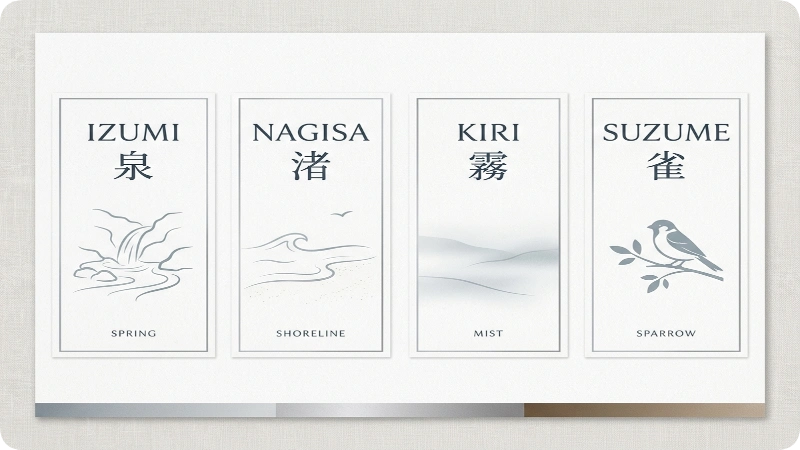
| Izumi | 泉 | Spring or fountain |
| Kiri | 霧 | Fog |
| Minato | 湊 | Harbor |
| Nagi | 凪 | Lull in the wind or calm conditions |
| Nagisa | 渚 | Shore or waterside |
| Namiko | 波子 | Wave + child |
| Shizuku | 雫 | Droplet |
| Sora | 空 | Sky |
| Taiga | 大河 | Great river |
| Umi | 海 | Sea |
If you want an understated name, Nagi offers a calm, minimalist sound. By contrast, Shizuku evokes a water droplet, and Nagisa brings to mind the edge where land meets water.
A name’s direct written meaning does not guarantee that Japanese speakers will interpret it as a conventional given name in every context. Therefore, check natural usage if you plan to use one for a child rather than a fictional character or pet.
Japanese Names Inspired by Light and the Sky
Names connected with sunlight, stars, and the sky can feel imaginative while retaining a clear linguistic connection. Still, it is important to distinguish literal meanings from symbolic associations.
Japanese Names Connected With Light and Stars
| Name | Kanji | Meaning or Association |
| Akari | 明里 | Brightness + village or place |
| Akira | 明 | Bright or clear |
| Asahi | 朝日 | Morning sun |
| Hikari | 光 | Light |
| Hikaru | 光 | Light |
| Hoshi | 星 | Star |
| Kōsei | 光星 | Light + star |
| Subaru | 昴 | The Pleiades star cluster |
| Tsukiko | 月子 | Moon + child |
| Yuzuki | 柚月 | Citron + moon |
Some of these names have straightforward character meanings, while others combine characters to create a particular interpretation. For example, Subaru has an established association with the Pleiades, while the example spellings of Kōsei, Tsukiko, and Yuzuki show specific kanji choices rather than universal definitions.
Japanese Names Inspired by the Moon and Seasons
| Name | Example Kanji | Meaning or Association |
| Aki | 秋 | Autumn |
| Fuyumi | 冬美 | Winter + beauty |
| Hazuki | 葉月 | Leaf + month |
| Haruka | 遥 | Distant or faraway |
| Haruna | 春菜 | Spring + greens |
| Mikazuki | 三日月 | Crescent moon |
| Mizuki | 美月 | Beauty + moon |
| Satsuki | 皐月 | Traditional name for the fifth lunar month |
| Tsuki | 月 | Moon |
| Yuki | 雪 | Snow |
Mikazuki is a particularly distinctive choice because 三日月 means “crescent moon.” However, it is also an ordinary Japanese word, so consider how it functions as a given name in your intended context. Similarly, some spellings, such as 美月 for Mizuki, combine character meanings rather than translating the whole name into one fixed phrase.
Rare Sounding and Distinctive Japanese Names

A name does not need to be invented to feel unusual to an English speaking audience. Some established Japanese names simply remain less familiar outside Japan. However, actual rarity depends on the country, age group, and period, so the following are best understood as distinctive options rather than a verified ranking of the rarest names.
Less Familiar Japanese Names to Consider
| Name | Kanji | Meaning or Association |
| Chiyo | 千代 | Thousand generations |
| Hotaru | 蛍 | Firefly |
| Isuzu | 五十鈴 | Fifty bells; a traditional written form |
| Kiyora | 清良 | Pure or clear + good |
| Kohaku | 琥珀 | Amber |
| Komachi | 小町 | Small + town or district in this written form |
| Mahiro | 真尋 | True + a measure of depth |
| Shion | 紫苑 | Aster flower |
| Suzume | 雀 | Sparrow |
| Tomoe | 巴 | A traditional comma shaped motif |
These names offer different kinds of distinction. For example, Kohaku connects with amber, while Suzume means “sparrow.” Chiyo has a traditional feel, and Tomoe carries a visual association with a recognizable Japanese motif.
A few cautions are important. The meaning of Isuzu depends on its written form and historical context, while Kiyora and Mahiro can have different readings or kanji choices. Confirm the exact characters and conventional use before treating any proposed combination as a standard name.
Traditional Japanese Names With Historical Character
| Name | Example Kanji | Meaning or Context |
| Chiyo | 千代 | Thousand generations |
| Fumiko | 文子 | Writing or literature + child |
| Hideko | 秀子 | Excellent + child |
| Masako | 雅子 | Elegant or refined + child |
| Sachiko | 幸子 | Happiness or good fortune + child |
| Shizuko | 静子 | Quiet or calm + child |
| Takako | 貴子 | Precious or noble + child |
| Toshiko | 敏子 | Quick or clever + child |
| Yoshiko | 良子 | Good + child |
| Yukiko | 雪子 | Snow + child |
Many of these names have a more traditional impression, particularly because of their use of 子 (ko, “child”). Nevertheless, their associations and popularity have changed across generations. They should not all be described as rare in Japan without specific naming statistics.
Japanese Names With Beautiful Kanji
Japanese writing gives parents and writers a way to explore meaning through individual characters. Yet, choosing kanji requires more care than translating a name from English.
Understanding Common Japanese Name Characters
| Kanji | Basic Meaning | Example Name |
| 愛 | Love or affection | Ai, Aiko |
| 花 | Flower | Hana |
| 光 | Light | Hikari, Hikaru |
| 空 | Sky | Sora |
| 月 | Moon | Tsuki |
| 海 | Sea | Umi |
| 桜 | Cherry blossom | Sakura |
| 雪 | Snow | Yuki |
| 蓮 | Lotus | Ren |
| 希 | Hope or wish | Nozomi |
These characters provide a useful starting point for understanding Japanese names. However, a character can have multiple readings, and some names use kanji partly for their sound rather than their literal meaning.
How Kanji Can Change a Name’s Meaning
Consider the name Aki. It can be written as 秋, meaning “autumn,” or with other characters associated with brightness or clarity. The pronunciation stays the same, but the written meaning changes.
Behind the Name
Similarly, the name Ai can use 愛, meaning “love or affection,” or 藍, meaning “indigo.” Therefore, a name’s romanized spelling alone cannot establish its exact meaning.
Before settling on a name, check:
- The intended kanji and their individual meanings.
- Whether the combination supports the intended reading.
- Whether Japanese speakers use that combination naturally as a given name.
- Whether the name has unintended meanings or associations.
- Whether the spelling works for your intended cultural and personal context.
How to Choose a Unique Japanese Name
A distinctive name should do more than look attractive on a list. It should also fit the purpose for which you need it, whether that is a baby name, a fictional character, an online identity, or a pet.
Choose a Name That Matches Your Preferred Meaning
Start with the idea that matters most to you. For example:
- Love: Ai (愛) or Aiko (愛子).
- Light: Hikari (光) or Hikaru (光).
- Nature: Kaede (楓), Sakura (桜), or Hotaru (蛍).
- Strength of character: Isamu (勇), associated with courage.
- The sky: Sora (空).
- The moon: Tsuki (月), the Japanese word for moon.
These are starting points, not interchangeable meanings. If you want a name with a precise meaning, choose its written form deliberately.
Consider Pronunciation and Spelling
Japanese names may contain sounds that English speakers pronounce differently at first. Long vowels also matter: for example, Yū and Yu do not necessarily represent the same pronunciation or name.
When writing Japanese names in English, macrons such as the line over ū or ō can indicate a long vowel. However, romanization practices vary, so follow the form preferred by the individual or family.
Match the Name to Its Intended Use
For a baby, prioritize natural usage, cultural connection, and the name’s long term suitability. For a fictional character, you can also consider historical period, family background, personality, and the setting of the story.
About username or pet, sound and memorability may matter more. Even then, accurate spelling and meaning can help you choose a name that feels intentional rather than randomly Japanese sounding.
Avoid Choosing Kanji by Meaning Alone
Two characters may have appealing meanings individually but may not form a conventional name with the pronunciation you want. In addition, some combinations have established readings that differ from what an English speaker might expect.
If cultural authenticity is important, consult a reliable Japanese language reference or a fluent speaker who understands naming conventions. This small step can prevent a beautiful looking name from carrying an unintended meaning.
Frequently Asked Questions About Unique Japanese Names
1. What are some unique Japanese names?
Distinctive options include Hotaru, Kohaku, Shizuku, Subaru, Suzume, Tomoe, and Nagi. Each has a different association, from fireflies and amber to stars, sparrows, and calm weather.
2. What is a beautiful Japanese name with a meaningful origin?
Hikari (光) means “light,” Sakura (桜) means “cherry blossom,” and Makoto (誠) means “sincerity.” The right choice depends on whether you prefer a nature based meaning, a visual image, or a personal virtue.
3. What Japanese girl names are unique?
Hotaru, Sumire, Tsubaki, Ayame, and Koharu are options to explore. Their example written forms connect with fireflies, violets, camellias, irises, and spring, respectively.
4. What are some distinctive Japanese boy names?
Isamu (勇), Takumi (匠), Minato (湊), Hayate (疾風), and Subaru (昴) are worth considering. They offer associations with courage, craftsmanship, harbors, swift winds, and the Pleiades.
5. Which Japanese names can be used for any gender?
Names with documented use across genders include Akira, Hikaru, Hikari, Kaede, and Makoto. However, the perceived gender of a name may depend on the kanji, region, and generation.
6. What Japanese name means moon?
Tsuki (月) is the Japanese word for “moon.” Names such as Mizuki and Yuzuki can also include 月 in particular kanji combinations, although their overall meanings depend on the characters chosen.
7. What Japanese name means light?
Hikari (光) means “light,” and Hikaru can also be written with 光. Akira may be written with 明, a character associated with brightness and clarity.
8. Do Japanese names have more than one meaning?
Yes. A name’s meaning can change when its kanji changes. Some names have several established spellings, and some kanji combinations emphasize pronunciation rather than a direct translation.
9. Are rare Japanese names always uncommon in Japan?
No. A name that seems unusual outside Japan may be familiar to Japanese speakers. To establish actual rarity, you need reliable statistics for a specific country and period.
10. How do I choose an authentic Japanese name?
Check its original spelling, intended pronunciation, kanji meanings, documented usage, and cultural associations. If you plan to give the name to a child or use it for a culturally specific character, seek guidance from a reliable Japanese language source or fluent speaker.
Key Takeaways
- Japanese names can draw meaning from nature, virtues, seasons, celestial objects, and traditional culture.
- Hotaru, Kohaku, Nagi, Shizuku, and Suzume are distinctive options with clear associations.
- Hikari, Hikaru, Akira, Kaede, and Makoto have documented use across genders.
- Kanji often determines a name’s meaning, so the romanized spelling alone may not tell the whole story.
- Verify pronunciation, natural usage, and cultural context before choosing a name for a child or a culturally specific character.
- Treat “unique” as a personal preference unless reliable statistics establish actual rarity.
Conclusion
Unique Japanese names offer a rich mix of nature, history, character, and symbolism. If you prefer names connected with the natural world, consider Hotaru, Kaede, or Shizuku. For a more celestial feel, explore Hikari, Subaru, or Tsuki. Meanwhile, Isamu and Makoto provide meaningful options associated with courage and sincerity.
Ultimately, the strongest choice is the one that suits your purpose and has a meaning you genuinely appreciate. Check the original kanji, pronunciation, and cultural context rather than relying on a translated name list alone.

Leave a Reply