Feature Snippet:
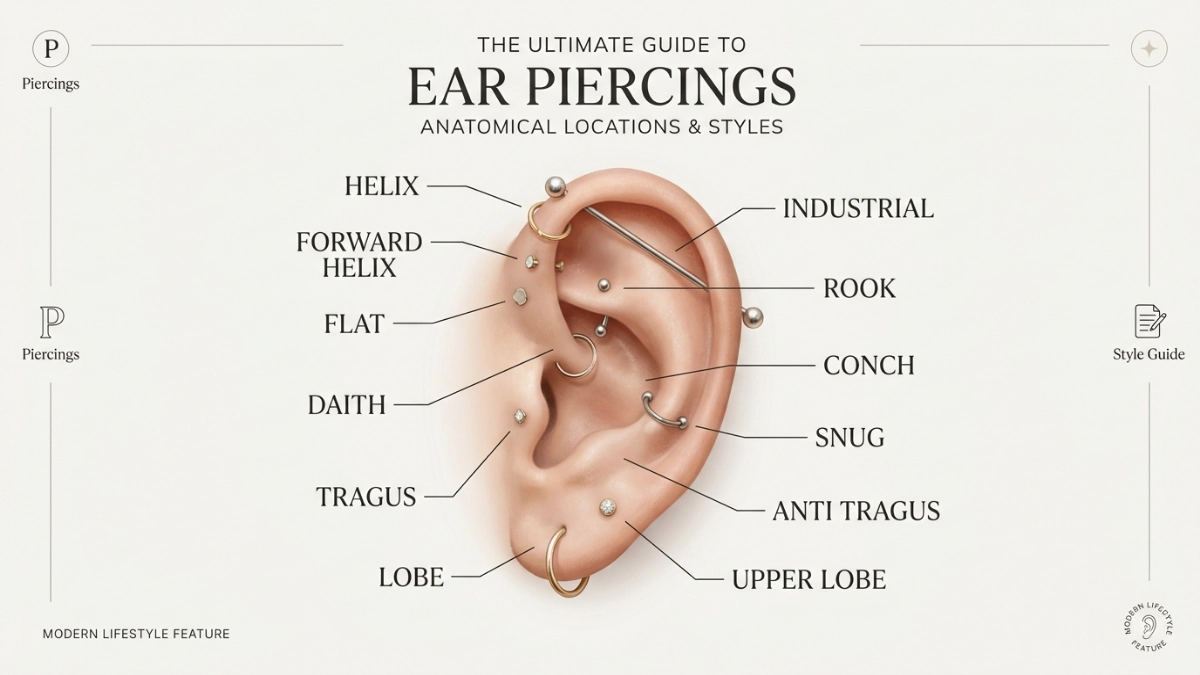
If you are searching for ear piercing names, you have probably noticed that ear piercings have many different names depending on where the jewelry sits. A classic lobe piercing looks very different from a helix, tragus, conch, rook, or daith piercing. Understanding these names makes it easier to describe the style you want, compare placements, and discuss jewelry options with a professional piercer. It can also help you understand why some piercings generally heal faster than others.
The earlobe is made from softer tissue and usually heals faster, while cartilage piercings tend to require a much longer healing period. Cleveland Clinic notes that lobe piercings commonly heal in about six to eight weeks, while several cartilage placements can take six months to a year.
Table of Contents
| Section | What You’ll Learn |
| Ear Piercing Names | The most common types and their locations |
| Lobe Piercings | Standard, upper, stacked, and related lobe styles |
| Cartilage Piercings | Helix, forward helix, conch, tragus, and more |
| Inner Ear Piercings | Rook and daith placements |
| Industrial Piercing | How the two hole barbell style works |
| Ear Piercing Placement | Where each type sits |
| Pain and Healing | What can affect discomfort and healing |
| Beginner Friendly Piercings | Options commonly considered easier to start with |
| Piercing Combinations | Ideas for creating an ear stack |
| Choosing a Piercing | Factors to consider before booking |
| FAQs | Answers to common ear piercing questions |
Ear Piercing Names and Their Meanings
The name of an ear piercing usually describes the part of the ear where the jewelry passes through. For example, a helix piercing goes through the upper outer cartilage, while a tragus piercing goes through the small cartilage area in front of the ear canal.
Here are some of the most commonly recognized names:
| Ear Piercing | General Placement | Tissue |
| Lobe | Lower fleshy part | Soft tissue |
| Upper Lobe | Higher section of lobe | Soft tissue |
| Stacked Lobe | Multiple lobe placements | Soft tissue |
| Helix | Upper outer rim | Cartilage |
| Forward Helix | Front upper cartilage | Cartilage |
| Flat | Flat upper ear area | Cartilage |
| Tragus | Small cartilage in front of ear canal | Cartilage |
| Anti Tragus | Cartilage opposite tragus | Cartilage |
| Conch | Inner cup of ear | Cartilage |
| Rook | Upper inner cartilage fold | Cartilage |
| Daith | Inner cartilage fold above ear canal | Cartilage |
| Snug | Inner cartilage fold | Cartilage |
| Industrial | Two upper cartilage holes connected by bar | Cartilage |
Exact anatomy and suitability can vary from ear to ear, so a professional piercer should assess your individual ear before deciding whether a particular placement is appropriate.
Lobe Piercing Names
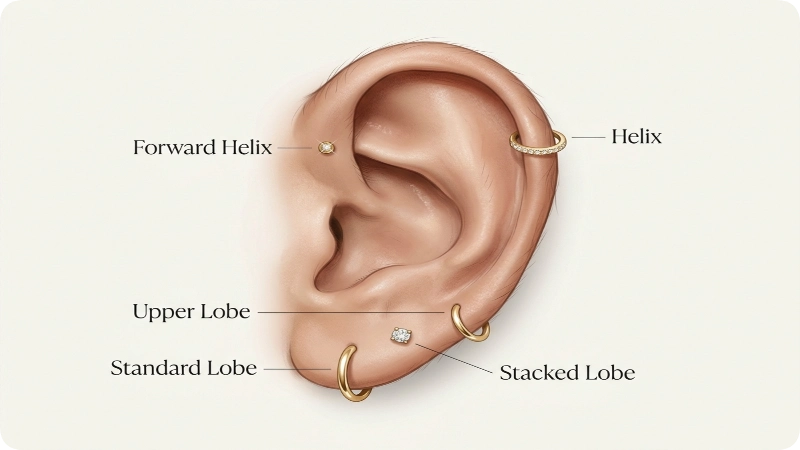
The lobe piercing is the classic ear piercing placed through the soft lower portion of the ear. It is one of the most common ear piercing choices and generally heals faster than cartilage piercings.
Standard Lobe Piercing
A standard lobe piercing sits in the lower fleshy portion of the ear. Many people start with this placement because it accommodates a wide variety of earrings.
Upper Lobe Piercing
An upper lobe piercing sits higher on the earlobe. It can create a layered appearance when combined with a standard lobe piercing.
Stacked Lobe Piercings
A stacked lobe arrangement uses multiple piercings positioned vertically or diagonally across the lobe. The exact arrangement depends on the available anatomy and desired jewelry combination.
| Lobe Style | Look | Jewelry Ideas |
| Standard lobe | Classic | Studs, hoops |
| Upper lobe | Layered | Small studs, tiny hoops |
| Double lobe | Coordinated | Matching studs |
| Triple lobe | More decorative | Mixed studs and hoops |
| Stacked lobe | Artistic | Small mixed jewelry |
Cartilage Ear Piercing Names
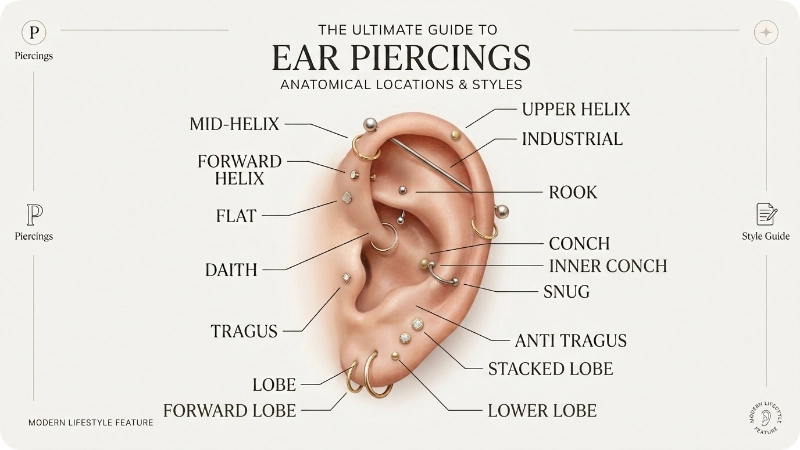
Cartilage piercings create many of the distinctive ear piercing styles seen in modern ear stacks. Popular examples include the helix, forward helix, tragus, conch, and flat piercing.
Because cartilage has less blood supply than soft tissue, it generally takes longer to heal. Cleveland Clinic estimates that cartilage piercings may take up to six months or even a year to fully heal.
Helix Piercing
A helix piercing goes through the cartilage along the upper outer edge of the ear. It is one of the most recognizable cartilage piercings.
You can also have multiple helix piercings along the outer rim to create a layered arrangement.
Forward Helix Piercing
A forward helix sits toward the front of the upper ear, closer to where the ear meets the head. Its position creates a different look from a traditional helix.
Flat Piercing
A flat piercing is placed through the relatively flat cartilage area on the upper part of the ear. Decorative studs often work particularly well with this placement.
Tragus Piercing
The tragus is the small piece of cartilage positioned immediately in front of the ear canal. A tragus piercing passes through this cartilage.
Because the placement is close to the ear canal, professional placement and suitable jewelry are especially important.
Conch Piercing
A conch piercing sits in the cup shaped central area of the ear. The name comes from the ear’s resemblance to a conch shell. Both inner and outer conch placements are used.
| Cartilage Piercing | Where It Sits | Overall Look |
| Helix | Upper outer rim | Classic and versatile |
| Forward helix | Front upper cartilage | Delicate |
| Flat | Upper flat cartilage | Minimal |
| Tragus | In front of ear canal | Subtle |
| Conch | Central ear cup | Bold but refined |
| Anti tragus | Opposite tragus | Unusual |
| Snug | Inner cartilage fold | Distinctive |
Inner Ear Piercing Names
Some ear piercing names refer to cartilage folds deeper inside the visible outer ear. Two particularly recognizable examples are the rook and daith.
Rook Piercing
A rook piercing passes through the inner edge of the upper cartilage ridge. It sits above the daith area and can create a distinctive curved jewelry look.
Not every ear has anatomy suitable for a rook piercing, so a professional assessment matters.
Daith Piercing
A daith piercing passes through a fold of cartilage near the entrance to the ear canal. The location is relatively thick and curved.
You may see claims online that daith piercings can prevent migraines. However, current medical evidence does not establish ear piercing as a migraine treatment. Cleveland Clinic specifically notes that there is no scientific evidence that daith or other ear piercings prevent migraines.
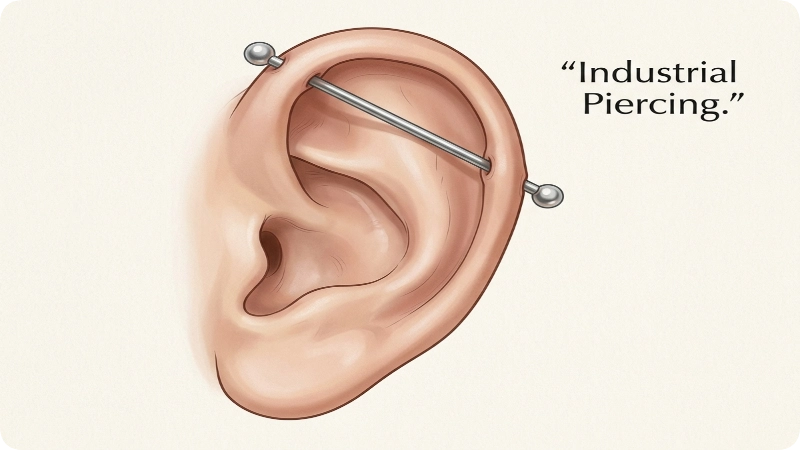
Industrial Ear Piercing
An industrial piercing typically involves two piercings connected by one barbell. It commonly crosses the upper cartilage of the ear.
Because an industrial piercing involves two healing sites connected by jewelry, it requires careful placement and aftercare. Ear anatomy also plays an important role in determining whether the traditional barbell configuration is suitable.
Industrial Piercing at a Glance
| Feature | Industrial Piercing |
| Number of holes | Usually two |
| Jewelry | Connecting barbell |
| Typical area | Upper ear cartilage |
| Style | Bold and structured |
| Tissue | Cartilage |
| Healing | Longer than lobe piercing |
| Anatomy | Must be assessed individually |
Ear Piercing Placement Chart
Knowing the placement names can make it easier to visualize an ear piercing combination.
| Area of Ear | Common Piercing Names |
| Lower lobe | Lobe |
| Upper lobe | Upper lobe |
| Outer upper rim | Helix |
| Front upper rim | Forward helix |
| Upper flat area | Flat |
| Central cup | Conch |
| Front of ear canal | Tragus |
| Inner upper fold | Rook |
| Inner fold near canal | Daith |
| Opposite tragus | Anti tragus |
| Inner cartilage fold | Snug |
| Upper cartilage bridge | Industrial |
The exact location can vary slightly between piercers and individual ear anatomy. For that reason, names are useful for communicating an idea, but a professional should determine the final placement.
Which Ear Piercing Hurts the Least?
Pain varies from person to person. Your individual pain tolerance, anatomy, piercing location, technique, and jewelry can all influence the experience.
Generally, the earlobe tends to be less uncomfortable than thicker cartilage placements. Healthline also notes that cartilage piercings such as the daith, rook, and conch can be more uncomfortable than softer ear tissue.
Instead of relying on a universal pain ranking, consider the type of tissue involved.
| Piercing Area | General Consideration |
| Earlobe | Softer tissue; usually easier to heal |
| Upper lobe | Still primarily soft tissue |
| Helix | Cartilage; longer healing |
| Tragus | Cartilage near ear canal |
| Conch | Thicker cartilage |
| Rook | Firm cartilage fold |
| Daith | Thick inner cartilage |
| Industrial | Two cartilage piercing sites |
Ear Piercing Healing Times
Healing times vary significantly. Your anatomy, jewelry, aftercare, irritation, and overall healing response can affect the process.
Cleveland Clinic reports that earlobe piercings tend to heal in around six to eight weeks, while cartilage piercings such as the helix, tragus, conch, rook, and daith may take six months to a year.
| Type | General Healing Consideration |
| Lobe | Usually faster |
| Upper lobe | Generally faster than cartilage |
| Helix | Longer healing period |
| Forward helix | Longer healing period |
| Tragus | Longer healing period |
| Conch | Longer healing period |
| Rook | Longer healing period |
| Daith | Longer healing period |
| Industrial | Extended cartilage healing |
These are general ranges rather than guarantees. A piercing should not be treated as fully healed simply because a minimum time period has passed.
Best Ear Piercings for Beginners

If this is your first piercing beyond a standard lobe, you may want to consider how easy the placement will be to protect and care for.
A lobe piercing is generally simpler to heal than cartilage because it involves softer tissue and usually heals faster.
For a beginner considering cartilage, discuss your anatomy, lifestyle, sleeping habits, headphones, helmets, hair, and jewelry preferences with a reputable professional piercer.
Beginner Considerations
- Start with a placement that fits your anatomy.
- Consider whether you regularly sleep on that side.
- Think about whether headphones will touch the piercing.
- Choose appropriate initial jewelry with your piercer.
- Be prepared for cartilage to heal more slowly.
- Avoid changing jewelry before the piercing has adequately healed.
Popular Ear Piercing Combinations
Once you understand the individual names, you can combine different placements to create an ear stack or curated ear look.
Minimal Ear Stack
A simple combination might include:
- Standard lobe
- Upper lobe
- Small helix
This creates a layered look without filling the entire ear.
Classic Ear Stack
Try combining:
- First lobe
- Second lobe
- Helix
- Conch
Small hoops and studs can create a balanced arrangement.
Bold Ear Stack
For a more dramatic arrangement, you might consider:
- Multiple lobe piercings
- Helix
- Forward helix
- Conch
- Tragus
- Industrial
However, more piercings also mean more healing sites and more aftercare. A professional piercer can help determine whether the combination makes sense for your anatomy and whether the placements should be done at the same time or spaced apart.
How to Choose the Right Ear Piercing
Consider Your Ear Anatomy
Not every ear can accommodate every piercing. The shape, size, folds, and cartilage structure of your ear influence which placements are suitable.
Think About Your Lifestyle
If you frequently wear headphones, helmets, glasses, or other equipment that touches your ear, some placements may be more convenient than others.
Consider Your Sleeping Position
A fresh cartilage piercing can become irritated when you repeatedly put pressure on it. If you usually sleep on one side, discuss placement options with your piercer.
Choose Appropriate Jewelry
Your professional piercer can recommend jewelry based on the location, anatomy, and stage of healing. Cleveland Clinic lists titanium, medical grade steel, and 14K gold among commonly recommended options and advises avoiding metals such as nickel if you have sensitivities.
Choose a Qualified Piercer
A professional should use appropriate sterile equipment and evaluate your anatomy before piercing. Piercing procedures can carry risks including infection, allergic reactions, and scarring or keloids.
Ear Piercing Aftercare Basics
A new piercing is a healing wound, so aftercare matters.
Keep the area clean according to the instructions provided by your professional piercer. Avoid unnecessary touching, twisting, or irritating the jewelry, and protect the piercing from repeated friction.
Watch for symptoms such as increasing redness, swelling, pain, or discharge. If you suspect an infection or have symptoms that concern you, seek medical advice rather than relying solely on home remedies.
Do not change jewelry simply because the piercing looks healed on the outside. The deeper tissue may still be healing, particularly with cartilage piercings.
Frequently Asked Questions About Ear Piercing Names
What are the main ear piercing names?
Common ear piercing names include lobe, upper lobe, helix, forward helix, flat, tragus, conch, rook, daith, anti tragus, snug, and industrial.
What is the most common ear piercing?
The earlobe piercing is one of the most common ear piercings. The earlobe contains softer tissue and generally heals faster than cartilage placements.
What is a helix piercing?
A helix piercing goes through the cartilage along the upper outer edge of the ear. It is one of the most recognizable cartilage piercing styles.
What is a tragus piercing?
A tragus piercing passes through the small cartilage section positioned in front of the ear canal.
What is a conch piercing?
A conch piercing goes through the cup shaped central area of the ear. It can be placed in the inner or outer conch area depending on anatomy and desired placement.
What is a rook piercing?
A rook piercing goes through an inner cartilage ridge in the upper portion of the ear. The exact suitability depends on the individual’s ear anatomy.
What is a daith piercing?
A daith piercing passes through a fold of cartilage near the entrance to the ear canal. Although some people claim that it helps with migraines, scientific evidence does not support ear piercing as a migraine treatment.
What is an industrial piercing?
An industrial piercing usually consists of two holes in the upper ear cartilage connected by a single barbell.
Which ear piercing heals the fastest?
Lobe piercings generally heal faster than cartilage piercings. Cleveland Clinic gives a typical healing period of about six to eight weeks for earlobes, while cartilage piercings can take six months to a year.
How do I choose the right ear piercing?
Consider your ear anatomy, desired appearance, lifestyle, sleeping habits, headphones or other equipment, jewelry preferences, and willingness to manage a longer healing period. A reputable professional piercer can assess your ear and recommend suitable placements.
Key Takeaways
- Lobe, helix, tragus, conch, rook, daith, and industrial are some of the best known ear piercing names.
- Lobe piercings use softer tissue and generally heal faster than cartilage piercings.
- Helix piercings sit along the upper outer ear.
- Tragus piercings sit in the cartilage immediately in front of the ear canal.
- Conch piercings sit in the central cup of the ear.
- Rook and daith piercings use inner cartilage folds.
- Industrial piercings typically connect two cartilage holes with one barbell.
- Individual anatomy determines whether a particular piercing is suitable.
- Cartilage piercings generally require much more patience during healing.
- Daith piercings should not be considered a proven treatment for migraines.
- Professional assessment and appropriate aftercare can help reduce piercing related complications.
Conclusion
Learning the different ear piercing names makes it much easier to choose and describe the style you want. From the classic lobe and elegant helix to the distinctive conch, tragus, rook, daith, and industrial, each placement creates a different look and involves different anatomy.
If you are planning a new piercing, focus on more than appearance. Consider your ear anatomy, lifestyle, jewelry preferences, healing requirements, and aftercare routine. Most importantly, work with a qualified professional who can assess the specific placement and explain what is appropriate for your ear.

Leave a Reply